Showing posts with label 64. Show all posts

Friday, July 19, 2013

Pipe Frame

History:

The normal pipe frame was the standard for many renditions of the Grand Prix. It was developed as a neutral platform for every racer, with no imbalanced properties. For this reason, the aspects of the racers themselves influenced the outcomes of the first few races. Eventually the Pipe Frame gave way to increased specialization and different Karts and their parts proliferated. Upon his entry to the seventh Grand Prix, Metal Mario stole an old Pipe Frame and retrofitted it himself in an effort to mimic the past of his namesake.

Appears in:

SMK
64
Super Circuit
7

The Pipe Frame was the only available Kart until everything started getting crazy in Double Dash. For years, Mario used Red, Luigi Green, Peach Pink, Toad Blue, Bowser Orange, DK Yellow, Yoshi Light Green, Koopa Light Blue, and Wario Purple. In 7, we've associated the Kart with Metal Mario for its metallic nature. It may be used by any racer, however. It's generally a good Kart, with boosts in every stat except for Land Speed and Weight, with nothing added or subtracted from Land Handling or Stability. It works exceptionally underwater, and would be a nice pairing with the Roller or Wood tires in heavy underwater courses. For non-aquatic adventures, slap on the Slick tires to compensate for that low Land Speed.


The Pipe Frame is a popular Kart used by Staff Ghosts, appearing nine times in time trials. As far as Normals go, it's used by Bowser on GBA Bowser Castle 1, Koopa Troopa in N64 Koopa Troopa Beach, Mario in SNES Mario Circuit 2, Daisy in GCN Daisy Cruiser, and Lakitu in SNES Rainbow Road. Notably, these are all Retro Courses, fitting for this Retro Kart. On the Expert side, it's used by Shy Guy in the Shy Guy Bazaar, Peach in Wuhu Loop, Luigi in N64 Luigi Raceway, and Toad in Wii Mushroom Gorge. No other Kart besides the Standard appears so often in Time Trials.

Because the Pipe Frame is slower and lighter than the Standard, it's a little better in the hands of heavier characters rather than lighter ones. Some of these issues may be mitigated by wheels, though, and the general enhancement of nearly every other stat makes it a pretty viable option.

Tuesday, January 1, 2013

Fake Item Box

History:

Races underwent many changes during the Second Grand Prix. For the first time, Item Boxes were created rather than panels. During the first wave of their production though, many proved faulty. Instead of giving an item, they would explode and crash the racer. Soon after the technique for Item Box creation was perfected though, competing companies made knockoffs that were still faulty and sold them to individual courses, much to the danger of competing racers. Eventually the Grand Prix Governing Body reconciled the safety of racers with the concerns of the many new and growing factories that had sprung up to support the Races. The faulty Item Boxes were slapped with an inverse Question Mark and progressively labelled "Fake." They would, however, be accessible by true Item Boxes and used by drivers during the course of a race.

The Fake Item Box appears in:

64
Double Dash
DS
Wii
7

There have been some variations of the Fake Item Box throughout the years, but the purpose has always generally been the same. It is another, more deceptive means than Bananas for Lead Drivers to knock around those racing behind them. Indeed in 64 while running over a Banana was salvageable, Fake Item Boxes meant certain doom. 64 was also the game where the boxes where most similar to genuine Item Boxes, the only difference being the position of the Question Mark. In later games the boxes were red, or as in DS, lack a Question Mark at all. These make the boxes a tad easier to avoid.

Another major progression of the Fake Item Boxes throughout the history of Mario Kart is their physical properties. In 64 they acted very similar to Bananas - they could be dragged behind a Kart in order to prevent a Shell from crashing into the back. They could also be destroyed by shells moments before running into them. Their only real difference from Bananas is again, its greater deception, larger size, and an inability to throw them forward.

Most of this changed in Double Dash. Shells and other character-specific projectiles such as Fireballs and Chain Chomps would now pass through Fake Item Boxes, both when dragged behind a Kart or laid on a track. When Karts are hit while dragging, the Item is not lost, though. The Fake Item Box can be launched forward, however, making it an offensive weapon as well, as tricky as it is to peg a moving Kart from far away.

There are many strategies to both using Fake Item Boxes and avoiding them. Careful racers who can memorize True Item Box locations on courses will not be deceived, even in 64. Still, they can be used effectively to block ramps or shortcuts, or at least narrow track sections where running into one is inevitable. Another good drop spot is in a cluster of True Item Boxes, possibly sitting directly on top of a True One, even though timing this can be difficult. Still, limiting the amount of Item Boxes accessible to the competition is a good thing. Their offensive use can still work in rare circumstances, although it's rare that they will appear in positions deep in the pack. If there is a situation where you receive a Fake Item Box and are then passed, it's best to try to chuck it into a crowd, or a particularly deadly maneuver is to launch it into a True Item Box cluster that another racer is about to pass through. It's tough to react to things falling out of the sky, and the CPU will rarely be able to anyway.

Boo

History:

Throughout the Course of Time there have been many deaths in the Mushroom World. When both Koopas and the Mushroom People fall victim to an unnatural death their souls may be unable to move on. This causes them to anchor to the World of the Living as ethereal Ghosts named Boos. They eventually forget their past lives and exist only to terrorize the living, from some instinctual urge to spread as the fear of moving on that has consumed them. As such they serve no living master and flit in and out of the races as they please. Their Commander, King Boo has taken part in the Grand Prix and many courses have been constructed over their lands. At times they have also found their way into Item Boxes, where their mischief leaks onto the races themselves. Their presence is not sanctioned by any Governing Body of the Grand Prix and they are not welcome, although they tend to be helpful to racers.

Boos appear in:

64
Super Circuit
DS

The Boo notably only appears in games similar to the 64 mold - games with a limited number of core characters but slightly advanced in course selection. It does appear in SMK, but only in multiplayer modes. Once activated, the Boo causes a few things to happen. Offensively it causes the racer and his or her Kart to turn incorporeal, allowing him or her to pass through garbage like Bananas and Shells strewn across the track, as well as to pass through other drivers. While this is happening the racer also vanishes from the course map and the screen of opponents, allowing for some very sneaky play.

In Super Circuit, the Boo also slows down the lead racer and causes him or her to lose coins. This feature vanishes from DS, but it also negates the slowdown caused by Offroad travel, allowing drivers to snip some shortcuts or at least not be hampered by mistakes or sloppy driving.

The other ability that Boos bestow is the theft of another item. Once activated, the Boo will travel to another nearby racer and steal his or her item and then bring it back to the activating racer. This is a handy defensive measure in that it takes away another driver's advantage and gives it to you. There's no telling what this Item may be though, and no real strategy to select it. Still, a free Item is always helpful. If no one around you has an Item, then this function is not activated.

Friday, May 18, 2012

Thunderbolt

History:

It was Bowser's Dark Magic that first harnessed the power of Lightning. Lying under the constantly stormy skies of the Dark Land, Bowser was able to capture the daggers from the sky and confine it to an Item Box. Known more often as the Thunderbolt, this item was seen as counter to the Benefits of the Star. It would destroy all other players and allow its user to race ahead.

The Thunderbolt appears in:

64
Super Circuit
Double Dash
DS
Wii
7

The use of the Thunderbolt is similar in every game. Usually players have to be pretty far bac64 and Super Circuit, where the effects lasted longer and players were squished if run over (this returned in 7). From Double Dash on, Players are merely knocked around more easily, and from DS on players in a lower place would be affected for a shorter period of time.
k to get it from an Item Box. Once activated, every other player on the course is struck by Lightning and shrinks down to a miniature size. This makes them much slower, as well as more vulnerable to hazards on the course, including other racers. It was arguably a more fearsome weapon in

The only thing that can counter Thunderbolts are Stars, or in later games, Bullet Bills. If a Racer in Wii is using a Mega Mushroom, he or she will be reduced to normal size. Mistimed Lightning is perhaps the most dangerous - if it strikes when going over a jump players will be punished into the Abyss. The only exception for many years was barrel cannons or other jumps that prevented the ill effects. When these kinds of jumps became conduits for Air Travel in 7 this protection was negated. This makes 7 a much more dangerous game, and indeed, with the squishing effect back in force, the Thunderbolt has some teeth again.

There's no telling when Lightning will strike. It's the number one reason not to hold on to items very long and is a great interrupter of strategy. From DS on, the Thunderbolt can cause players struck to lose their items, which was absent from 64 and Super Circuit. Generally this seems to happen whenever you've been holding a Red Shell for just the perfect moment to strike. It promotes a healthy turnover in gameplay.

Saturday, May 12, 2012

Shells

History:

When the first Grand Prix Council got together to determine what Items would be used, Bowser proudly volunteered an offensive options: The Koopa Shell. At first he only supplied standard Green Shells, but eventually his Shell Technology grew more sophisticated. He added homing powers with Red Shells from Paratroopas and finally, the Blue Spiny Shell, one of the most rare and deadly of any of the Mario Kart Items. For the 2003 Tournament he added his own Bowser Shell, the most monstrous and gigantic of all Shells.

The Green Shell Appears in:


SMK
64
Super Circuit
Double Dash
DS
Wii
7

The Green Shell is one of the most basic, stalwart offensive options in Mario Kart. It has hardly changed since its earliest days in Mario Kart History. Once fired it travels in a straight line, bouncing off any solid wall until it crashes into a racer or falls off an edge. It can also be used defensively, being held behind a Kart similar to a Banana, where it will absorb the hit of any other Shell or shell-like item (This option was unavailable in Double Dash). It can be fired behind the racer when held here, which is helpful in some instances, for instance if a player is far ahead and there is a higher danger of firing it forward.

The Triple Green Shell Appears in:

64
Super Circuit
Double Dash*
DS
Wii
7

The Triple Green Shell in practice acts exactly like a Green Shell,  a straightforward projectile. It is also a very able defensive weapon, though, because once activated, all three shells will encircle a player. If drivers run into anyone else, the result will be as if the opponent had hit a Green Shell. Players are still susceptible to damage, though, if an Item penetrates the Shell Guard players will still flail out. This is less an issue when all three are activated but when only one or two shells are circling around players are more vulnerable. Of course, they are no more vulnerable than if they had nothing at all.

*In Double Dash this was a Special Item reserved for Koopa Troopa and Paratroopa. The Shells did not encircle the players, making them less useful defensively, but still a great offensive option.

The Red Shell Appears in:

64
Super Circuit
Double Dash
DS
Wii
7

The Red Shell has been a staple of Mario Kart games from 64 on. It fires forward like a Green Shell, but instead of traveling in a straight line and then bouncing off walls it homes in on the closest player ahead in the race. It will become defunct if it strikes a wall though, necessitating a degree of precision during Battle Matches with many walls, such as SMK's Battle Course 4.


The Triple Red Shell Appears in:

64
Super Circuit
Double Dash*
DS
Wii
7

The Triple Red Shell once activated acts exactly like the Triple Green Shell, encircling and protecting players. Once fired they act exactly like Single Red Shells, homing in on enemy players.

*In Double Dash this was a Special Item that only Koopa Troopa and Paratroopa could use. They did not circle around the Kart, making them less useful defensively, but they are very valuable to use to specifically attack a wide number of opponents.

The Blue Spiny Shell Appears in:

64
Super Circuit
Double Dash
DS
Wii
7

This is another fairly rare and legendary Item. It often comes up while racers are near the back of the herd and is one of the only such weapons that his used offensively from back there. Using the shell's wings, it flies and seeks out whoever is in First Place and messes up their day. From Double Dash on the disaster has become more significant, causing a great Blue Explosion that will also engulf any players driving around the Blue Shell.

It is possible to avoid the Shell, but this is tricky and lucky to do. The key is that the Shell doesn't pick its victim until that final plunge, which is where you can escape. Still, there are dangerous parts of the track where getting hit is not only inescapable, it proves disastrous. This includes over any gap and particularly in Mario Kart 7 in many Air Portions.

The Bowser Shell Appears in:


Double Dash

The Bowser Shell is the Special Item of Bowser and Bowser, Jr. in Double Dash and is a pretty useful item. The enormity of the shell takes up most of any track and it will clobber anyone in its path. There is some caution when throwing it forward though, as the thrower may become a victim as well. It's best on straightaways shot directly behind to annihilate anyone who is considering challenging you. It can be disrupted by Giant Bananas, although it will destroy the Banana, as well as Hearts, which can pick it up to be used by either Peach or Daisy.

The Yoshi Egg Appears in:


Double Dash

The Yoshi Egg has properties very similar to Shells, so it is included here. Technically the Yoshi Egg is the Special Item of Yoshi (as well as Boo and Petey Piranha) and a pink version, the Birdo Egg is the Special Item of Birdo. Both have exactly the same function and operate basically like a Red Shell, seeking out and destroying whoever the next in line is. The key though, is that once struck, the Egg will crack open with Items such as Stars, Mushrooms, Bananas, or Stationary Green Shells. It could also pop open a Bob-Omb. All this means that the Egg could either be very beneficial to the user, or it could be hazardous. It's even possible that the enemy struck will come away with a star. It's not that useful.

Bananas

History:

There is nothing more valuable on the DK Isle than Bananas. In a land rich with currency, Kong holds nothing above his precious Golden Banana Collection. During the Original Grand Prix when the Council deemed that every competing civilisation give up something substantial to contribute to the Item Panels, Kong let go of a few thousand Bananas. Ever since then, they have been a staple of the Tournament.

The Banana Peel Appears in:


SMK
64
Super Circuit
Double Dash
DS
Wii
7

The Banana Peel has appeared in every game since Mario Kart's inception. It is the primary defensive weapon and the most common weapon dropped behind players rather than in front. It can be used offensively by throwing it forward, but this is difficult to pull off with precision. Different games handled the Banana in different ways. In every game besides Double Dash players can hold the banana behind their cart as a defense against Shells and shell-like items, although if the Shell comes in by the Front or Side of the Kart this is useless.

In Mario Kart 64 players could also recover from crossing a banana if they didn't immediately peel out. In other games, Bananas lead to certain doom. It's always an Item more commonly encountered in Higher Places during the race and careful placement on the track will ensure it remains that way.

The Banana Bunch Appears in:


64

Mario Kart 64 also boasts the only appearance of the Banana Bunch. A version would return as the Triple Banana in later games, but 64 is the only one to feature the succession of five peels dragging behind a Kart. Not only did this allow players to leave longer trails of hazards, but they would have more dangers dangling behind their vehicles for players who travel too close to run into.

The Giant Banana Appears in:


Double Dash

This is an Special Item reserved for Donkey Kong and Diddy Kong. The Giant Banana is as it sounds - a monstrous frowny banana that takes up most of the track. it is one of the better defensive options and great for players ahead in Grand Prix because it will come up often and block everyone coming up the rear.

Once players strike the Giant Banana it will break up into Three smaller Bananas. The same effect will happen when a Bowser Shell hits it or a Chain-Chomp munches through it.

The Triple Banana Appears in:


DS
Wii
7

Ever since DS multiple Bananas have come in groups of three, not five like the Banana bunch. Besides limiting the amount of obstacles drivers can leave on the course there is no real difference here.

Mushrooms

History:

While the Mushroom People covet neither coins, nor bananas, nor stars, their main love is Mushrooms. Such huge Mushrooms are plentiful in the Mushroom Kingdom and shared by all. The love of Mushroom Breeding takes the interest of many Mushroom People and there have been developed many different varieties. When deciding the Items to be included in the Initial Grand Prix, the Council argued for hours over what resources the different lands should give up. It was eventually decided that the Dark Land would supply thousands of Green Shells while the Mushroom Kingdom would give up many of their own Mushrooms for the success of the Games.

The Mushroom Appears in:


SMK
64
Super Circuit
Double Dash
DS
Wii
7

The Mushroom works similarly in every game and has made an appearance in everything since SMK. It provides Drivers with a sudden, temporary burst of speed that allows them to cut through offroad patches, knock around other players, or just gain some ground. It does not, however, render players invincible, and as such they are still vulnerable to any hazard the Course has to offer. If during this speed boost, players hit other drivers they will steal an opposing item. In Battle Mode this means that players will steal a balloon.

There are other ways to get Mushrooms on a course. Sometimes they are hidden in boxes or under piles of leaves, and if Goombas are struck by Lightning they will revert to their once-innocent Mushroom status.

The Triple Mushroom Appears In:

64
Super Circuit
Double Dash
DS
Wii
7

This item has is identical to the Mushroom but players receive three at a time. Since it was introduced in 64, it has been included in every game to date.


The Super/Golden Mushroom Appears In:


64
Double Dash*
DS
Wii
7

Known as either the Super Mushroom or the Golden Mushroom, this has appeared in every game since 64 with the exception of Super Circuit. Once activated, it grants players the effect of a Mushroom for an unlimited amount of times within a limited time period. This is another item that players will often receive when they are hanging out towards the back of the pack, and can be dangerous if they are activated on a complex course with many edges leading to the Abyss.

*In Double Dash this item was not available to everyone, but rather it existed as Toad and Toadette's Special Item. It is not that useful because it will not appear if players are in a High Position already. Therefore it is more well-suited for novices.

The Mega Mushroom Appears In:


Wii

The Mega Mushroom gives players the effect of what Mushrooms typically do to Mario in mainstream games: Make Huge. Once huge, players will get a speed boost as well as the ability to crush other players and obstacles. Nigh omnipotent, Mega Mushrooms still fall prey to the Star.

Star

History:

Stars are the source of the most ancient power in the Galaxy. The combined power of the Stars fuels Rosalina's godlike abilities, and when twisted, most of the Dark Lord Bowser's as well. It can sustain entire Galaxies or Kingdoms in power and the limitations of their use are determined solely by the mortals using them. In the hands of someone pure, like Mario, the Stars are used to rejuvenate and replenish decimated Kingdoms and Peoples. In the hands of Bowser they are used only to torment and destroy.

Their use in Mario Kart was controversial. They are so powerful that when setting the Items many racers had reservations, which come up whenever the Council decides what to include in the next Grand Prix. It was determined in the initial Tournament that the effects of a Starman be temporary, but during that time, very substantial indeed.

The Star Appears in:


SMK
64
Super Circuit
Double Dash
DS
Wii
7

The Star is the end-all of all items. It supersedes every other Item and ability. When using it players are invincible, their speed becomes comparable to the use of a continuous Mushroom, and they don't lose anything by traveling over rough terrain. If you are lucky enough to get one, usually when closer to the bottom of the pack, there is nothing better for making your own shortcut.

The Star beats Bowser Shells, Giant Bananas, Chain Chomps, Bob-Ombs, and Fireballs in Double Dash. In Wii it takes precedence over players activating either Bullet Bills or Mega Mushrooms. In all games players will be invulnerable to Lighting as well as Blooper Attacks. The only thing that can halt the Power of the Stars is a plummet into the Abyss.

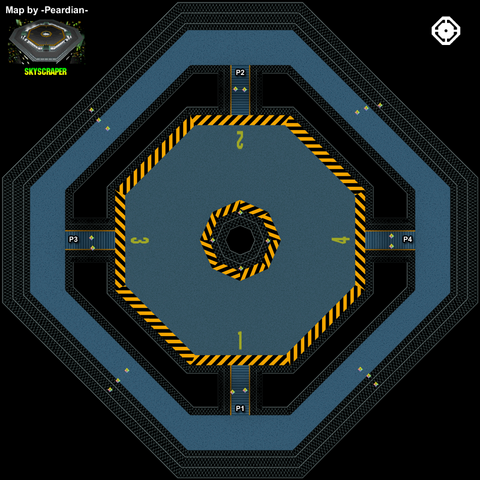
Skyscraper

History:

With the wild upsurge in Battle Courses, development became a hot commodity in the mid-90s, although it still paled in comparison to Grand Prix Tracks. Toad, always the cunning and conniving politician who had his hands in a plethora of business deals, turned the roof of the Flagship Skyscraper in Mushroom City into a popular course. With a gorgeous view of the surrounding city, the Skyscraper tract attracted many to Mushroom City - just as Toad predicated.

64:

Skyscraper is a dangerous course. The outer edges all lead to the Abyss, as do cracks separating the inner circle to the outer rim. The very center is also a pit towards death. The rest, though, is relatively wide open, which means Battlers are open to destruction. Because of the open edges and plenty of drops though, Shells do not last long or bounce around with any frequency, meaning that if you are going to take someone out you have to be precise.

The track returned as a Retro Stage in Wii. Its layout is not tremendously different although it is much, much bigger. It is also more colourful and the ramps around any of the edges are far more exaggerated. Most of the action is on the outer room, driving loops and jousting with enemies. The center is generally hazardous like most Battle Stages and as things spread out along the Rim things are safer.

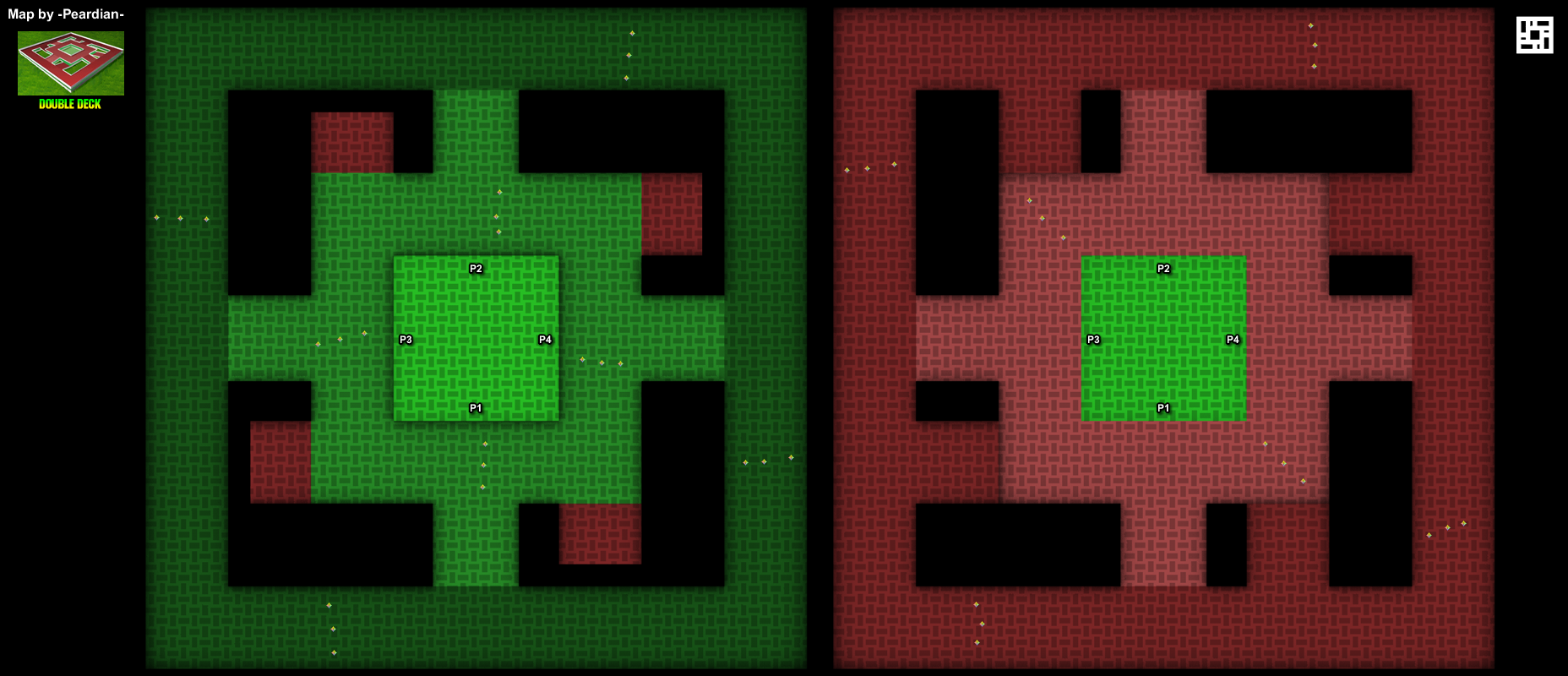
Double Deck

History:

Luigi, always in the shadow of his brother, Mario, sought to develop his own Battle Stages after seeing Mario successfully do so. He put tremendous resources into creating Double Deck, a shoddy complex battle stage at best. It was always second to Block Fort, though, a trait that perennial second banana Luigi never forgot.


64:

Double Deck is maddening. As its name suggests, it consists of two major decks, one red and one green. There is, however, multiple levels on these decks as well as a large central platform on a separate level. This is another stage where errant Green Shells can be the death of a Battler, especially as they work their way down to the lowest levels. It's a tough Stage to wrap one's head around and it's easy to get lost trying to find someone to battle. This course could use a remake, as it may do better with 10-16 players rather than the 4-limit of 64.

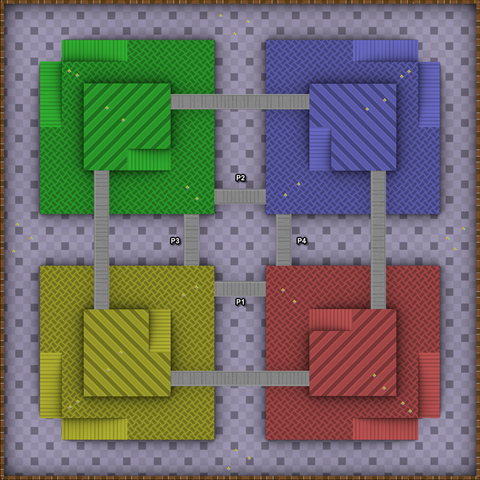
Block Stages

History:

The First Block Stage was created by Mario for the second installment of the Kart Games. Named Block Fort, it lay in the heart of the Mushroom Kingdom and provided the greatest Battle Spectacle of the time. Within a few years with Mario busy with other properties it came into the hands of Donkey Kong, who heavily renovated the arena, transforming it into Block City. As it fell into disrepair over the years, Mario eventually won back the rights. This time, though, he decided to share it with Luigi, Peach, and Daisy, who issued joint control of the stage. As such they erected massive statues of themselves in the course to demonstrate their wide control over Battling Interests.

64:

Each Console Mario Kart has a Block Stage, although the first is superior to all others. Block Fort is a multi-leveled splatterfest and one of the more popular stages out there. After a few rounds of Triple Green Shells the lower levels become almost undrivable, and the top most tend to have narrow pathways that are easy to get blown off. There are plenty of tight corners to interrupt the paths of Red Shells and clusters of Item Boxes perfect for drops of Fake Item Boxes. Any ramp can also become deadly with a string of Banana Peels. Also because of its straightaways it's one of the easier courses to ram smaller players and rob them of a Balloon.

The Course returned in DS with much brighter hues than the N64 standard Green, Yellow, Red, and Blue. Not a tremendous has changed besides the addition of a few items, most notably the Bob-Omb.

Double Dash:

Block City is one of the simplest courses in Mario Kart History, but that also makes it one of the most effective. It is small and essentially flat, although there is a slight incline leading up from the dead-end corner by the Blue Sector. There isn't really anything fancy about each sector, besides the pathway through the Yellow Blocks and the ability of the Blue Block to shadow some portions of the course. There isn't a safe part of this track, and items like Bowser Shells and Giant Bananas can devastate the narrow corridors. Because of the confined nature of the Stage you may have more success with smaller players, but ultimately a Red Shell will find its target no matter who you are.

Wii:

Block Plaza essentially combines bits from both Block Fort and Block City. Like Block Fort it has multiple levels connected by ramps and boardwalks. The block structure, notably the cut through the yellow path, though, and its low, confined nature is reminiscent of Block City.

Unlike either of these though, after a few minutes of play parts of the stage descend into the abyss, creating dangerous gaps for players to descend to their doom. It also has quadrants of each colour like Block City, but the main ramps lead to big bases with statues of Mario, Daisy, Peach, and Luigi that offset these quadrants, as well as a central purple base in the center. This makes for very different gameplay than the other cutthroat Block Stages. The High ground is essential here, using Shells or even Bananas, one can pick off doomed players. The Center Ring tends to be deadly, while the outer rims are where much of the killing can take place if you corner players one-on-one.

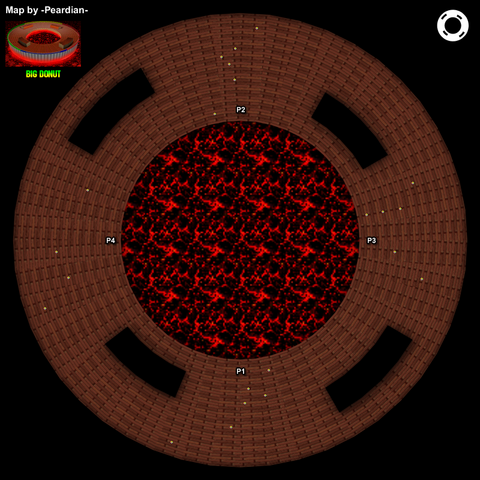
Big Donut

History:

After being left out of any Battle Stage construction in the previous Kart Games, Bowser created the Big Donut in the midst of the Great Lava Seas that engulf parts of the Dark Land. When its popularity increased enough over the years to be featured in the latest installment of the Games, Bowser added some special features, such as his own Koopa Clown Car hovering in the center O.

64:

Big Donut is just about everything it would appear to be. It is a huge donut-shaped Battle Stage. The center is full of inescapable lava, which is more dangerous than it appears. Other than that and some large walls most of this stage is open, which allows for both increased danger and increased inability to find anybody. The whole stage slopes towards the evil center, which doesn't necessarily increase the danger, but doesn't make it any easier.

The Stage returned in Mario Kart 7 as a Retro Battle Course. The big change is the addition of Air Boosts that allow players to fly across the diameter of the Donut. Take caution, though, as lightning or Blue Shells can make this a dangerous trip indeed. There are also air blowers and lava spouts to contend with in this journey. It is the only Battle Course in Mario Kart that allows for Air Travel. With the increased amount of players in 7 it also becomes a much more interesting Stage. Four players was never really enough here, it was very difficult to run into enemies while taking laps around the big loop. Playing with a higher number of Battlers, though, greatly increases the possibilities of chaos. A similar thing happened with a similarly shaped stage, Cookie Land when it went from Double Dash to Wii.

Thursday, May 10, 2012

Rainbow Road

History:

The original Grand Prix Racers struggled to come up with a culmination of their collective efforts. They eventually found a solution in the Sky - using their combined powers and the almost unlimited potential of Stars, they created the first Rainbow Road. They continued to operate in tandem for years, creating a truly non-partisan final course. After the turn of the Century though, this became unwieldy. With the growing popularity of Racers' personal tracks and investments it became difficult for them to join together to create the Rainbow Road. Still using Star Power, they decided to delegate its construction to a smaller committee.

SMK Rainbow Road in Mario Kart 7

In 2001 Bowser's presence was felt in Rainbow Road and he oversaw construction closely from his Floating Castle. In 2003 this fell to Mario and Peach who worked together using their formidable resources to construct the track floating over Mushroom City. Other parties, notably Bowser, resented this and in the next Tournament it fell to R.O.B. who had less of a bias. As R.O.B. did not participate in any other Grand Prix, Rosalina used her vast Galactic Powers to construct the next track in the fringes of the Mushroom World's Atmosphere. Finally, the latest track was overseen by the Honey Queen, who stepped in and used her wide sphere of influence to construct a track across the planets themselves. Lakitu, after decades of his species officiating the races also stepped in to revive the Original Rainbow Road course.

SMK:

Rainbow Road has been one of the most consistent conventions of the Mario Kart series. It always concludes the Special Cup and serves as the Final Course in the game and usually one of the more difficult. No Rainbow Road has any Offroad and they are always suspended in space or the sky, which means that there is a constant danger of falling into the abyss. SMK's Rainbow Road doesn't have the most difficult turns in the game and is completely flat, but its trickiness is precisely that: It is full of 90° turns that come right after long straightaways and with exactly zero guardrails the course is perilous indeed. There are also thwomps that smash players and a few narrower portions where it's easy to get knocked around (and off). Its rainbow portions make up a sort of tile on the track.

Like every course from SMK, this was re-made in Super Circuit. The course also returned in Mario Kart 7 to conclude the Lightning Cup, the Final Retro Cup. It is largely similar although now when the thwomps pound the shockwave makes the track bouncy. It is also one of only two courses (the other being N64 Luigi's Raceway) to have no Air or Sea portions. The Ghost is Lakitu. Using the Pipe Frame, Slim Wheels, and Super Glider, the Normal Staff Ghost goes 01:34.459. This could be advantageous, as his Drift, Mini-Turbo, and Handling are top-notch at the expense of speed.The Expert Ghost goes 01:21.994 using the Cloud 9, Roller Wheels, and Paraglider. The Roller Wheels play into both the Cloud 9's strengths and weaknesses. Still, neither Ghost has all that much speed. If you can get going and not fall off, it should be a cinch.

64:

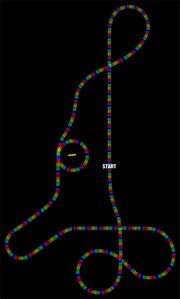
I consider 64's incarnation of Rainbow Road to be the grandest of them all. It is by far the longest course in Mario Kart history, usually taking around six minutes to complete. It is the only Rainbow Road completely surrounded by guardrails but there is danger both from errant shells bouncing around forever on the course as well as from the hungry chain chomps that roll by to ruin a Driver's day. More than that though, with its grand hills, long straightaways, and extremely tight turns, the course offers a bit for every playing style. Without a tremendous amount of interruptions, it allows these playing styles to play out. That is, whoever wins Rainbow Road a true driving champion. It is also so extravagantly long that players have time to catch up if they get the right items, or conversely based on skill, time to create an impressive lead.

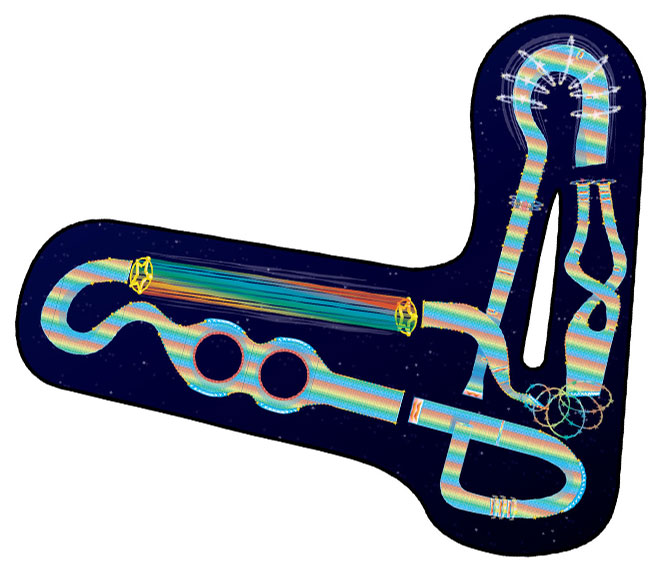
The track is in the reaches of space, like the version from SMK. There are neon images hovering above the track of each Racer, as well as some items like Boo and the Mushroom. The track itself is much smoother than SMK, comprised of horizontal bands of every major colour in the Rainbow.

This course returned to close out the Lightning Cup in Mario Kart 8. There are some other major differences, including the presence of air jumps near the start and finish as well as large portions of the track now transformed into anti-gravity sections. It's really a bastardized version, though, because it has been transformed from taking three laps to only one, similar to Mount Wario, the Wuhu Tracks, or the Rainbow Road from 7. This makes the course much easier, although there are now spots lacking guardrails, which makes things slightly tougher. The Chain Chomps also no longer roam like maniacs but merely bounce up and down, shaking up the course. The only other major geographical difference is that it now takes place over a city, similar to Double Dash, instead of in the middle of space. The rainbow itself is also tiled more similar to SMK than the clean strips we saw in 64. All in all, despite the anti-gravity sections being pretty awesome, it's a big step down.

The Ghost this time around is Metal Mario, a signifier of his other-worldly nature, but also very in line with both Mario and ROB being previous Ghosts of these tracks. He uses the Standard ATV for some insane reason, with Monster Tires and Super Glider. There's no reason to need that level of traction and almost anything is going to get you going faster. Handling is an issue here, use lighter weights sparingly.

Super Circuit:


The Super Circuit incarnation combines some elements from both SMK and 64. Its pattern is similar to 64 but with a brighter tone and it shares a large amount of tight turns, but the whole course is flat. There is also a fair amount of both guardrails and gaps to endanger Racers. There are boost panels for the first time, which tend to hinder novices but excite veterans. Some of these, as well as Mushrooms, can provide some significant shortcuts to blast through this course.

For the first time, too, the track is not in space but clearly in the night sky. Players drive by clouds, which can land on players, shrinking them down. Bowser's Castle is also a constant presence in the background.

Double Dash:

Rainbow Road started getting really crazy in Double Dash, living up to its status as the Ultimate Test of a Mario Karter's Mettle. Like Super Circuit it contains both stretches with guardrails and very dangerous unguarded portions that can lead to certain doom. It also brings back Dash Panels, the course is full of them, which can be dangerous or a benefit depending on a Player's skill level. While looking down on the course from above it may not seem like much but there are extreme changes in elevation that can make the course very difficult as it is full of spiral turns that require excellent driving to get through. There is also an enormous vertical boost, the only one of its kind.


The Track itself is suspended over Mushroom City, making it another course that is in the Sky and not Space. The course is almost panel like, and it glistens in faded Rainbow Colours that merge, blend, and reflect with each other. The track is also very bumpy, and green shells are virtually useless. There is the occasional Star that lands, however. Still, items like the Star or Golden Mushroom can prove more fatal than beneficial. Like 64 there are objects suspended across the course, this time each characters' Special Item. They are more three-dimensional than the 2-D Neon Glow of 64, though.

Double Dash only had one set of Staff Ghosts. The pair here are Mario and Peach, the only such Ghost Team of unnatural pairs. Using Mario's Red Fire they pull a 3:16:476. This makes it the longest course in the game. It is again a course that can fit many playing styles and mastering drifting while staying on the middle of the track will lead to success.

DS:

What appears as a simple Figure-8 is much more. The DS version of Rainbow Road features the only full Loop in Mario Kart History, as well as a difficult Spiral Track. In the vein of recent Rainbow Roads this track is full of Dash Panels and mixes guarded sections with difficult sharp turns that offer no protection. The key here though, is both the Loop and the Spiral and players must be cautious about being hit with Blue Shells or Thunderbolts as they'll plummet to their doom.

The Track is back in Space although it has a blue rather than black hue, suggesting it may still be somewhere in the Upper Atmosphere. The course itself has vertical rather than horizontal bands of Rainbow Colours and looks more similar in tone to SMK than the brighter, faded hues of Double Dash or Super Circuit.

The Ghost here is R.O.B. in the R.O.B.-BLS who goes 2:16:246. R.O.B. is a weird robot and so fits the weirdness or the ultimateness of this course. This version requires good drifting ability as most of the straightaways are full of dash panels anyway, and the toughest parts in Time Trials are surely the turns and not the Loop. Many of DK's Karts such as the Wildlife and Rambi Rider have both high speed and drift and may be a good option. It is actually by a good margin not the longest track in the game, that distinction goes to Waluigi Pinball.

Wii:

This perhaps the craziest Rainbow Road, almost an unbelievable judgment. Like the courses from 64 and Double Dash it begins with a steep drop, although in this incarnation the drop is no hill but a sheer cliff. There are Boost Panels everywhere, along with spots to pull some tricks and many unguarded sections besides a few turns and the starting point. Its most distinctive feature may be the wavy section that drops down into a wide section of track punctured by two massive holes that lead to oblivion. Following this is a Star Warp that sends the players high above and across a great distance to the final third. It's similar to the Vertical Boost from Double Dash, but it travels horizontally a great deal as well.

The Course finds a median between Sky and Space and is clearly positioned very high in the Earth's Atmosphere. Players who fall off will begin to burn up in re-entry. Visible though, are moons, planets, bits of debris, and star bits floating around the cosmos. The track itself is similar to Double Dash, a reflective shimmering rainbow, although it is not as opaque or bleached out.

The Ghost here is Rosalina, reflective of her Galactic Status. The Normal Ghost appropriately uses the Shooting Star in 03:05.895 while the Expert switches to the Jetsetter in 02:44.734. Both do well in the hands of Rosalina. Karts are a bit more stable and perform better than Bikes here. Funky's speed applied to the Flame Flyer is a great option, but again, the course has bits to fit any playing style. In terms of length, the course barely beats Bowser's Castle to be the longest Original Track in the game but it is actually still shorter than the N64 version of Bowser's Castle, which closes out the Retro Tracks.

7:

The Final Rainbow Road to date is truly Galactic. 7 introduced the idea that courses could be only one lap, albeit a very long one. After Wuhu Loop and Maka Wuhu the last one-Lap track is this game's installment of Rainbow Road.  There are not as many drastic elevation changes, but there are extended Air Portions, multiple path choices, and a wavy road full of holes reminiscent of the Wii version. This time, however, players drop down to the surface of a Moon. Dash panels abound again, and one of the course's more distinct features may be a long Rainbow Tube that doesn't quite do what the Spiral in DS did.

The Course is truly in space. For the first time Players can drive not only on bits of Rainbow but the rings of a Saturn-like Planet as well as what appears to be the surface of a moon. There a a few places to catch some Air, the longer of which is full of Asteroids to dodge and Star Boosts to hit to keep up Air Travel. Failing to hit these can lead a Driver to either the course below or death. The track itself is a swirl of colours that evokes the vertical pattern of DS but gives it a greater swirl like Wii.

The Ghost here is the Honey Queen, perhaps due to her status as Intergalactic Royalty. The Normal uses the Birthday Girl, Slim Wheels, and Peach Parasol in 02:10.090 . This is a pretty good choice, but the Peach Parasol is egregiously slow in the air. The Expert switches to her own Bumble V, Standard Wheels, and Flower Glider in 01:52.077. This is again solid, although the Glider can definitely be upgraded. There are more turns, gaps, and last-minute decisions to be made her than a need for raw speed. The greatest straightaways are through the air, so pick someone with good handling and drift that maintains velocity in the Air. Something like the Bumble V, Cloud 9, or Pipe Frame, along with the Sponge or Wood Tires ought to do the job.

8:

The Rainbow Road here returns to much of what made the Wii Rainbow Road great - set high in space with the Earth down below, with insane, impossible turns, split sections, and a massive air boost. Like 7, though, there is also some significant sections where no rainbow is traveled on, instead there exists a massive orbiting space station with shifting directional paths. It's also notable for being the only Rainbow Road with a small patch of Off-Road, though. It's completely allergic to barriers, and very easy to fall off when zooming along with anti-gravity. Anti-gravity, by the way, was made for this course, and it employs them perhaps better, or at least more extensively than any other course in 8.

Depending on your comfortability with that, you'll surely want someone with proper handling that won't fall into the abyss. The Ghost here is Pink Gold Peach, who uses the Comet, Slim Tires, and Super Glider. That's a damn fast combination but you can use the Slick Tires to get that anti-gravity speed up and perhaps someone with less weight for better handling during those deadly turns. The use of Peach in her Pink Gold diecast here may be a reference to her Ghost from Double Dash, along with the use of Metal Mario in the 64 Rainbow Road.

Monday, April 16, 2012

In-Depth Course Data

Selecting a racer to fit a track is one of the most important features of any Mario Kart game. Why select someone with great offroad abilities if the track has no offroad portions? In Mario Kart 7 this becomes even more important when courses offer extensive travel by Air and Sea. The following charts distinguish some different course aspects:

For the following post observe this key:

Super Mario Kart
Mario Kart 64
Mario Kart Super Circuit
Mario Kart Double Dash!!
Mario Kart DS
Mario Kart Wii
Mario Kart 7

Terrain:


Terrain doesn't really matter, but it's interesting. The most common kind of Terrain is pavement, followed by Dirt. There are much more Combinations of Terrain, though, more often in the later games such as DS, Wii, and 7. The most varied terrain often come in Beach or Water courses. Cheep Cheep Beach from DS has long stretches of sandy beaches, wooden piers, and a dirt track jungle section. Both Pipe Tracks, Koopa Cape and Piranha Plant Slide have four different varieties of terrain.

Koopa Cape is also the only course with glass sections in its long pipe portions. Other unique terrain include the Keyboards in 7's Music Park and Carpet Sections in that game's version of Mario Circuit and Bowser's Castle, as well as DS's Luigi's Mansion. There are also the three bizarre unique tracks from Super Circuit, Cheese Land, Ribbon Road, and Sky Garden. Of course, in every game there is a Rainbow Road track made out of Rainbow. 7 has the unique feature of splitting its Rainbow Road between Rainbow and a Planet's Surface, though.

Other interesting tidbits include the sand tracks making up Deserts and Beaches, the decline of Ice Tracks and surge of Metal Tracks, as well as Wood. There are many small wooden bridges in different courses (Riverside Park, Peach Gardens, etc), but we tried to include predominant Terrain, mostly material that took up at least a quarter of a track. Every pure Wood course was a Ghost Track until Daisy Cruser in Double Dash.

Edges:


We have four categories for the amount of Edges a course can have. Continuous Edges include tracks that have a constant danger, surrounded by the Abyss, as in Ghost Tracks, Lava, as in Bowser Castles, as well as Sky and Space in the Rainbow Roads and Sky Garden. As noted, Sky Garden lacks edges, although there are plenty of offroad buffers, Rainbow Road 64 is the only Rainbow Road with a continuous guardrail, and Rainbow Road SMK is the only course with no guardrail at all.

Limited Edges are by far the most populous kind of courses. These are courses where racers can fall off at some point. This includes small gaps such as in Coconut Mall or Shy Guy Bazaar, cliff edges for limited sections of track such as Moonview Highway or Wario Colosseum or even long stretches such as Yoshi Valley or DK Mountain. Finally, this also includes tracks that are landlocked but still have kart-destroying hazards such as the water in the SMK Donut Plains Tracks, Toad's Factory, and Desert Hills.

The Shore courses are mostly Beach and Desert Tracks. They involve the gradual destruction of karts tho not a hard edge. The best example is Koopa Troopa Beach, where you can certainly die in the water, but you're not falling off anything. The same goes for Dry Dry Desert, and even Frappe Snowland, where you can drive off into oblivion. These courses do not have walls limiting the driver's exploration.

Finally, we have true Landlocked Tracks, where there is no way without severe glitching that racers can fall off. This includes many of the easier Circuit Courses, but also some surprises like DK Pass, Sunset Wilds, and Cheep Cheep Cape.

Offroad:


This is the most important course feature to understand and memorize. We have developed Five Different Standards of Offroad that are found in Mario Kart. The first is unavoidable sections, Offroad that is Essential to Course. This is whenever you must travel over Offroad with no option to go around. These are the most important to consider when picking a driver. The best examples are Shy Guy Beach and Luigi's Mansion.

The second are All-Encompassing. The tracks on these courses are surrounded or mostly surrounded by Offroad and usually they can be used for shortcuts to skimp across sections of track. Many courses are like this, from Grumble Volcano to most Mario Circuits. Also included are tracks with small but important Offroad portions that are essential for shortcuts, such as Waluigi Stadium and Mushroom Bridge.

Next we have courses where Offroad is existent but cannot really be used for any gain. Basically, while it's there, there's no reason it should be traversed and it's much less important to pick a Driver who has good Offroad. Basically the only advantage of using one of these characters here would to have less catastrophic consequences after a screw-up. These include many Luigi Circuits, but also much more complex courses filled with other dangers, such as Dino Dino Jungle and Mushroom Gorge.

There are also courses that have very limited Offroad sections that could affect gameplay but only in very isolated portions. Unlike Waluigi Stadium, for instance, though, they can't really be used for shortcuts. While the Existent Courses are essentially all-encompasing but do not affect gameplay, the tracks with limited offroad offer only small chunks. A lot of Bowser's Castle are like this, but there's also weird little bits in tracks like Music Park and Toad's Factory.

Finally, and perhaps most importantly, there are courses that completely lack any Offroad at all. There are actually more of these courses than any other, which is a substantial fact (although there are certainly more Offroad Tracks combined). These include every Rainbow Road, most Bowser Castles, and most Ghost Tracks. There are also city courses like Toad's Turnpike and Mushroom City as well as some surprises like Sherbert Land 64 and Maple Treeway.

Mario Kart 7:


Mario Kart 7 presents the interesting issue of combining Air and Sea travel with the standard Land Travel. Air and Sea speed and handling significantly change based on Driver, Kart, Wheel, and Glider selection, but that shouldn't matter depending on what course is chosen. Many tracks have some kind of Air Travel (23/32), but sometimes this can be avoided. A smaller number involve Sea travel (8/32), and some have both, especially later courses. Only the retro Luigi's Raceway and Rainbow Road lack any kind of either Air or Sea, so you need to prepare for something in most cases. Also depending on your skills, you may be able to avoid Sea Travel (in Koopa Troopa Beach, Daisy Cruiser, and Rosalina's Ice World), although this may not be the most direct option.

Wednesday, August 24, 2011

Yoshi Valley

History:

Yoshi never had a lot of money. It was cheap then to convert a large desolate valley in Dinosaur Land on the borders of the Donut Plains into a Race Course. Yoshi didn't specify an exact path however, and his course instead winds through the sun-baked valley as a huge maze, with little direction. It was never that profitable, though, and after years of low attendance and difficult viewing spots by spectators, as well as the angering fact that no one ever knew who was in first or last place, Yoshi   was forced to close it down in the late 90s.

Fates shifted and the young Dinosaur was able to re-open the Valley as a Nature Sanctuary for his own people in time for the 2014 Grand Prix. The Valley underwent some tremendous changes in the nearly twenty years in between exhibitions, but much of the maze was preserved.

64:

Yoshi Valley first appeared in MK64, and there's never really been another track like it before or since. Yoshi's had plenty of tracks but they've all been pretty different. Super Circuit featured Yoshi Desert, it became Yoshi Circuit in Double Dash and the Jungle Track Yoshi Falls in DS. It's interesting that Yoshi  is so adaptable to different course styles, but this was the original.

It mostly features a Giant Yoshi Egg which is the only overt connection to Yoshi himself. There's also tons of pesky porcupines, some dangerous cliff edges and finally, plenty of paths to choose from. Some of the variable paths are clearly better than the others but here are a couple of your best bets:


This path veers towards the left once the maze starts, which is tough because it goes through a porcupine-filled stretch as well as a narrow tricky path with no guardrails. If you can maintain a course without killing yourself though this is one of the straightest ways to go with only one major turn in the maze itself, although that one may be too out of the way.


This is the broadest, safest route, with not a porcupine in sight. It's also incredibly slow as it takes the driver on the most extreme route through the valley. This might be alright for Beginners or those racing in the 50 cc cup with terribly stupid computer players. Then again, you can get a long way by taking the shorter, more dangerous routes there.


This would be a nice route if not for the brutal 360° turn near the end with the threats of Porcupines, a drop and a lot of speed going into the Central Mountain. The first narrow bridge is also a tricky shoot to make. In all, not a great path to take.


This is going to be the fastest route, but it's also probably the most hazardous. Porcupines abound, but it's still very direct if you can avoid them. It's also the wider tunnel and it has no major turns or brushes with the edges or extremes of the course. Still, those Porcupines can be Satanic, so watch out. Just make it to the huge Center Mountain and you'll be fine. There are some other paths through the Valley but they're all derivative of these four main routes. Mostly the trade off is safety for slowness, but that's typical for Mario Kart. A good driver here is going to have good control, there isn't a whole lot of room to get some nasty speed going.

8:

This course returns as the Final Course of the Retro Leaf Cup in Mario Kart 8 with some of the greatest changes ever for a course remake. These are primarily cosmetic, as the course adds more mountains, rivers, water falls, and slight alterations in the hills and landscape to make the course feel very different. There are other more oblique alterations, though. That Red Route above now holds a Barrel Cannon to Air Blast players along the long distance. The Green Route also had its bridge replaced with a tunnel, which doesn't change too much but feels hella weird.

There are some other differences. The porcupines are now Goombas, and the Final Egg is significantly smaller. The Staff Ghost here is Yoshi, of course, who pulls a 2:28.814 using the Wild Wiggler, Standard Tires, and the Flower Glider. It's the only Ghost that features the Wild Wiggler as well as the Flower Glider. Considering that Air Travel is optional and not really the best route, you can bypass that entirely. The Wiggler is decent, not much Speed lost for heavy improvements in Handling. Throw on some Metal Tires to make it even more fearsome.

Tuesday, August 23, 2011

DK Tracks

History:

After Kong raced in his first Grand Prix he had a very strong desire to create some tracks of his own outside the Mushroom Kingdom, however he lacked the capital. The currency on DK Island at the time was the Banana, and the population was small and friendly enough to engage in a simplistic bargaining system. Eventually coinage was introduced to the Island, possibly from contact with the Mushroom Kingdom, and it became a very capitalistic society. Kong was eventually able to raise enough to create D.K.'s Jungle Parkway that ran through the Heart of the Kongo Jungle, near where Kong made his home.  Nearby he was also eventually able to construct a track leading from the Kongo Jungle to the nearby Monkey Mountains, using his Barrel Cannon technology to traverse an otherwise impenetrable section of Mountain. This was more recent in the History of DK Island, as the once-chilly Gorilla Glacier had since given way to massive Volcanic Areas.

Kong eventually moved away from the Jungle Tracks on his own Island, perhaps he regretted the influx of Tourism and Mushroom Influence directly on his own land. He staked out the Northern Kremisphere, a huge continent located far North of DK Island, although with plenty of pleasant spots. Through his friend Dixie Kong, he was introduced to Blizzard Bear who had already been attempting to convert some stretches of the base of K3 into Race Courses. Here Kong was able to open up the DK Pass to the Grand Prix, as well as the DK Summit, which was soon infested by vacationing Shy Guys who seem to have an uncanny love for Winter Sports.

The most recent Kong Track innovation has been back to the Jungle, this time very close to DK's home, including a race around his actual house as well as the Holiest of Kong Lands, the Golden Temple, home of the Golden Banana Horde. Although this seems counter-intuitive to the best interests of Kong, it appears as if he has moved his most prized possessions elsewhere, suggesting that its whole presence in the latest Grand Prix is a red herring.

64:

Kong got his first track in MK64, and it's notable for featuring a huge jungle as well as a massive jump, the latter of which would define most DK Tracks in the future. This is also the first Jungle Track, but I decided that there were enough similarities between all of Kong's Personal Courses that the Jungle Tracks should be separate. There's actually plenty of tough turns here, mostly because any error puts drivers in the high grassy median, where they are assaulted by Coconuts until he or she spins out. The narrow bridge, easy shortcut up the dirt cave and the huge jump are the big features here. This track opens up the Special Cup and is difficult enough to deserve that.

This track came back in Wii where the Ghost is Kong himself. He uses the Phantom in 02:58.264 then the Expert comes back with a 02:37.782 in the Flame Flyer. This version is notably wider than the 64 version, and the Coconut Chuckers are also gone for some reason. In general the track is easier, although the Cave shortcut is much steeper and more difficult to pull off without a mushroom.

Double Dash:

DK Mountain in Double Dash is a lot like D.K.'s Jungle Parkway. It's a Jungle Trek with a huge jump, dangerous rocks and a narrow wooden bridge near its finale. There is, of course, a huge difference in its basic layout. It's the first Mario Kart track that was largely linear, with a huge automatic boost that takes most of the course. Wii would use this template plenty, but its inspiration was probably the big jump from 64 (in addition to Royal Raceway). This track closed the Star Cup and as such is similar in Grand Prix location as Jungle Parkway was. There is also a difficult shortcut, jumping over a section of twisty track that has disastrous results for failure. I try to pick someone who can turn and accelerate to nail it, as well as someone who isn't going to bounce and lose tons of speed on the ragged hills. The Boo Pipes seem a good fit.

Double Dash had a series of Secret Staff Ghosts. The Ghost here is Kong driving his own DK Jumbo with Diddy in tow at 2:12:639. This track was the second DK Track to return for Wii, where the Ghost this time is Funky Kong at 02:57.744 in the Wario Bike. The Expert goes 02:38.130 using the Flame Flyer, one of the faster Ghost Combos in the game. The Wii version again features a noticeably wider track and a few Boost Panels. There are so many Barrel Cannon-type levels in Wii that this course had to make an appearance.

DS:

DK Pass is the only Original Snow Course in DS and so shares some characteristics with the Frosty Tracks, like the Terrible Snowmen. It also opens up the Star Cup in DS, which Snow Land did in Super Circuit and Sherbert Land did in Double Dash, belaying the simple fact that every other Game besides Wii has also featured a Frosty Track somewhere in the Star Cup. It also features giant Snowballs, like the Rocks from DK Mountain.

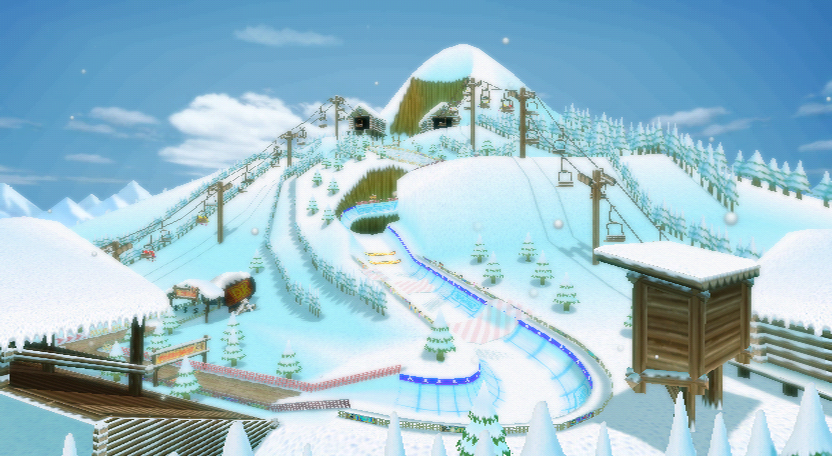
Mostly though, it is a true Mountain course in its layout, with a huge uphill section and then a huge downhill section, which makes it more akin with DK Mountain and DK Summit than any other Frosty Track. In general it's nice to see the makers of Mario Kart realise that there are more locations in the Donkey Kong Games than jungles, and their use of snow, which should have been Gorilla Glacier until Donkey Kong Country Returns got rid of it. This is a tricky course with mostly a limited path of road then snow with some huge drop-offs without a lot of room for error. There are some snow patches to blow through on your way up though. Someone light with good Offroad is important then, otherwise you can speed through this. The Staff Ghost is Kong using the Wildlife in 2:14:607.

This course returns in Mario Kart 7 with more of its ramps offroad to be accessed by mushrooms and tricks and with some Gliding action near the big ending jump. The Ghost is Donkey Kong using the Barrel Train, Wood Wheels, and Super Glider in 02:35.045. This leaves his speed moderate, handling pretty good, and mini-turbo outstanding. The Expert goes 02:16.534 using the Bolt Buggy, Red Monster Wheels and Parafoil, which is a very good combo here. To beat it, something that handles well while succeeding off-road navigator is vital. Go for the Koopa Clown with Red Monster Tires.

Wii:

DK Summit is basically a combination of DK Pass and DK Mountain. It seems like it's a focal point for Winter Sports, including Ski Lifts and Lodges as well as plenty of pesky Snowboarding Shy Guys, who seem like a holdover from the Sherbert Land of Double Dash, which featured them Ice-skating. The Barrel Cannon appears again, this time even sooner than it did on DK Mountain, and the remainder of the Track is a long downward journey, at times turning into a half-pipe down to the bottom. It's a slippery track, I've actually had a whole lot of luck with Bowser driving the Honeycoupe. You don't need someone knocking you into the gaping abyss during Grand Prix. The Ghost here is Kong again, this time using the Standard Bike L in 02:34.693. The Expert uses the Flame Flyer in 02:17.546. This is also the only DK Track to appear in the Flower Cup, and only the second Frosty Track to do so.

It deserves mentioning that Wii's Maple Treeway also features a Barrel Cannon and uses Diddy as its ghost, proving some relation to the DK Tracks. It is such a weird track filled with many more Mushroom Kingdom references though, so we won't talk about it more here.

7:

DK Jungle takes an identical position to D.K.'s Jungle Parkway in MK64, opening up the Special Cup. It lakes a huge barrel jump but does reflect changes Donkey Kong has had within the Nintendo gaming world. It is heavily inspired by Donkey Kong Country Returns and includes many of those enemies as obstacles. There is a river and a big Flower Jump, along with a wood bridge, but none are as distinctive as in D.K.'s Jungle Parkway. Instead, the most distinctive element is the huge Golden Temple that really shifts gameplay in the middle of the track, giving some right angle turns, a series of boost jumps and treacherous falls. There are many tough turns, obstacles and a good amount of air time, anyone with fast air speed, good stability is key. Use the Roller Wheels and Ghastly Glider with whatever Kart fits your play style.

 The Normal Ghost here is Kong himself, using the Bolt Buggy with Red Monster Wheels and the Super Glider in 02:24.040. The Expert goes a 02:10.777 using the Wood Wheels with the Standard and Swoop Glider, which should hurt its air speed. Stick with the above-recommended customization.

DK Jungle returns in Mario Kart 8, in the Banana Cup. It's not tremendously unchanged from 7, especially due to the fact that 8 retained the air travel and jump elements that makes a pretty smooth transition. There is the addition of a large anti-gravity portion in the Golden Temple, which makes the already difficult right-angle turns a bit more complex. The Ghost here is DK once again, pulling a 2:26.900 using the Varmint, Monster Wheels, and Super Glider. The Varmint and the Monster's stats nearly cancel each other out but ends up with slight boosts in traction and min-turbo. There are enough straightaways to favor some pretty fast racers, Sport Bike will do with whatever level of handling you need from the driver.

Monday, August 22, 2011

Royal Tracks

History:

Soon after the young Princess Peach was thrust into the Rule of the Mushroom Kingdom in 1983 after the death of her Father, the Kingdom fell into Financial Ruin. Since the Mushroom People are not naturally capitalistic they remained mostly ignorant however, and their simple farming and trading ways were hardly affected. Some of the larger Banks of Mushroom City and beyond were launched into Crisis though, and many foreclosed. It wasn't until the Racing Grand Prix that began in the early 90s did the economy get a shot in the arm. Not only did more people pay huge sums of cash to see the races, many different parties developed Tracks across the Kingdom, which led to massive Population Movements. It wasn't long then, until with the advice of Toad, her Consigliere, that Peach developed the Royal Raceway on what used to be her Personal Grounds. While later her suitor Mario would develop his own tracks on Private Royal land, Peach also founded the Peach Circuit immediately South of her Official Lands as well as her expansive Private Gardens, the Peach Gardens, which were full of tamed Chain Chomps.

In addition to all this, Daisy, Princess and Ruler of Sarasaland also recently developed a course on the Isle of Delfino, which has proved incredibly popular with both the native Piantas and residents of the Mushroom Kingdom on vacation. We've included it here as the only other Circuit Track sponsored by a Royal Princess.

64:

The Royal Raceway is mostly known for two things: 1) The Enormous Jump and 2) Access to Peach's Castle. This was an early direct link to a previous Mario Adventure Game, in this case, Super Mario 64, where the Castle is identical and that game's primary setting. It's fitting that the final Award Ceremony also takes place here, giving some Center to the Races in the Mushroom Kingdom. Peach's course is also the center for the Award Ceremony in Double Dash, at Peach Beach.

As the third course in the Star Cup, it's one of the more-advanced Circuit tracks, and it proves it. This course has tons of deceptively dangerous turns, taking any too wide on the slopes towards the lake results in instantaneous failure. If the Big Jump is misjudged it may also lead to a crash into the Mountains. Some grassy sections actually prove nice cut-through spots if you have a Mushroom or Star, but ultimately you need trustworthy handling here to succeed.

Super Circuit:

Super Circuit broke tradition by making Peach Circuit the First Course in the Mushroom Cup.Every game since has featured a Luigi Circuit or something very similar. That said, this isn't a whole lot like Royal Raceway. The Castle is close but inaccessible and there is a ton of grassy corners to cut. There isn't really a character who is poor here. It's very straightforward. This track came back in DS along with the first track from SMK, Mario Circuit 1 and the first track from Double Dash, Luigi Circuit to make up the Shell Cup. It was all a conspiracy to not have an all-Luigi Circuit Cup, for sure. The Ghost here is Peach driving the Royale with a time of 1:12:011.

DS:

Peach Gardens is a unique course with lots of possible turns and paths along with some of the nicest Chain Chomps to be found in a Mario Kart game. It's also in the Special Cup, which is extremely tame in DS. There are some hills that aren't too difficult and not a whole lot of danger outside of some moles, a water hazard that is very easy to avoid and the aforementioned Chomps, who don't chase you but rather stay on their own path. There are plenty of right-angle turns, but the path is actually so wide in these places that it's never that difficult. The same goes for weaving between the large Southern Hedge. Go for someone like Bowser with speed here with impunity. The Ghost is Peach in the Royale again with a time of 1:52:989.

This track also came back in Wii without a whole lot of difference. The Ghost here is Baby Peach this time, clearly loving playing in her Big-Ass Garden. The Normal does a 02:34.894 in the Magikruiser, the Expert pulls a 02:16.777 in the Mini Beast. Again, you can take speed here, Funky in the Spear is perfect.

Wii:

Like I said, I've lumped the Daisy Circuit in here because it's one of the only Circuit Tracks in Wii (actually every Original Cup except for the Special opens with a Circuit Track) and it's more similar to be lumped in here than any place else. It does have some unique elements though. Its seaside village aspects may make it more similar to Delfino Plaza and its Sunset Time recalls Waluigi Stadium. It's a Royal Road, though so it ends up here. It opens up the Star Cup here and is pretty straightforward besides some city twists and gentle curves. Actually the more I look at it the more I realise this is a hodge-podge track. The "8" midway through comes back in Wii's Rainbow Road, and the two sections of track right next to each other looks like an Early Luigi Circuit. Like the other recent Royal Tracks though, someone with tons of Speed can make it through here. It's pretty well suited to Daisy herself in the Mach Bike.

The Ghost is exactly that. Daisy goes a 01:56.822 in the Royal Racer, then the Expert does a 01:41.362 in the Mach Bike.