History:
The original Grand Prix Racers struggled to come up with a culmination of their collective efforts. They eventually found a solution in the Sky - using their combined powers and the almost unlimited potential of Stars, they created the first Rainbow Road. They continued to operate in tandem for years, creating a truly non-partisan final course. After the turn of the Century though, this became unwieldy. With the growing popularity of Racers' personal tracks and investments it became difficult for them to join together to create the Rainbow Road. Still using Star Power, they decided to delegate its construction to a smaller committee.
 |
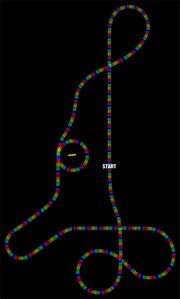
| SMK Rainbow Road in Mario Kart 7 |
In 2001 Bowser's presence was felt in Rainbow Road and he oversaw construction closely from his
Floating Castle. In 2003 this fell to Mario and Peach who worked together using their formidable resources to construct the track floating over Mushroom City. Other parties, notably Bowser, resented this and in the next Tournament it fell to R.O.B. who had less of a bias. As R.O.B. did not participate in any other Grand Prix, Rosalina used her vast Galactic Powers to construct the next track in the fringes of the Mushroom World's Atmosphere. Finally, the latest track was overseen by the Honey Queen, who stepped in and used her wide sphere of influence to construct a track across the planets themselves. Lakitu, after decades of his species officiating the races also stepped in to revive the Original Rainbow Road course.
SMK:
Rainbow Road has been one of the most consistent conventions of the Mario Kart series. It always concludes the Special Cup and serves as the Final Course in the game and usually one of the more difficult. No Rainbow Road has any Offroad and they are always suspended in space or the sky, which means that there is a constant danger of falling into the abyss. SMK's Rainbow Road doesn't have the most difficult turns in the game and is completely flat, but its trickiness is precisely that: It is full of 90
° turns that come right after long straightaways and with exactly zero guardrails the course is perilous indeed. There are also thwomps that smash players and a few narrower portions where it's easy to get knocked around (and off). Its rainbow portions make up a sort of tile on the track.
Like every course from SMK, this was re-made in Super Circuit. The course also returned in Mario Kart 7 to conclude the Lightning Cup, the Final Retro Cup. It is largely similar although now when the thwomps pound the shockwave makes the track bouncy. It is also one of only two courses (the other being N64 Luigi's Raceway) to have no Air or Sea portions. The Ghost is Lakitu. Using the Pipe Frame, Slim Wheels, and Super Glider, the Normal Staff Ghost goes 01:34.459. This could be advantageous, as his
Drift, Mini-Turbo, and Handling are top-notch at the expense of speed.The Expert Ghost goes 01:21.994 using
the Cloud 9, Roller Wheels, and Paraglider. The Roller Wheels play into both the Cloud 9's strengths and weaknesses. Still, neither Ghost has all that much speed. If you can get going and not fall off, it should be a cinch.
64:
I consider 64's incarnation of Rainbow Road to be the grandest of them all. It is by far the longest course in Mario Kart history, usually taking around six minutes to complete. It is the only Rainbow Road completely surrounded by guardrails but there is danger both from errant shells bouncing around forever on the course as well as from the hungry chain chomps that roll by to ruin a Driver's day. More than that though, with its grand hills, long straightaways, and extremely tight turns, the course offers a bit for every playing style. Without a tremendous amount of interruptions, it allows these playing styles to play out. That is, whoever wins Rainbow Road a true driving champion. It is also so extravagantly long that players have time to catch up if they get the right items, or conversely based on skill, time to create an impressive lead.
The track is in the reaches of space, like the version from SMK. There are neon images hovering above the track of each Racer, as well as some items like Boo and the Mushroom. The track itself is much smoother than SMK, comprised of horizontal bands of every major colour in the Rainbow.
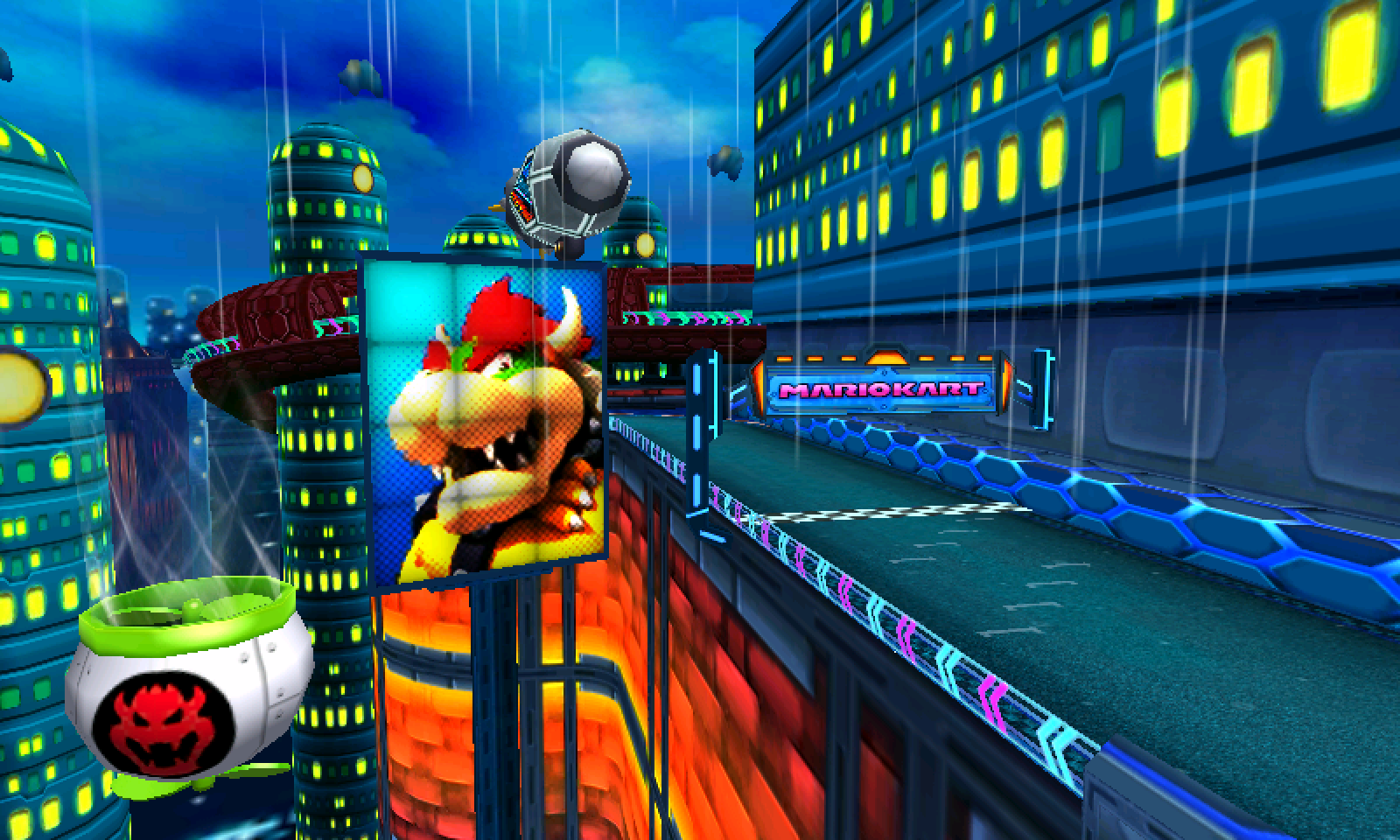
This course returned to close out the Lightning Cup in Mario Kart 8. There are some other major differences, including the presence of air jumps near the start and finish as well as large portions of the track now transformed into anti-gravity sections. It's really a bastardized version, though, because it has been transformed from taking three laps to only one, similar to
Mount Wario, the
Wuhu Tracks, or the Rainbow Road from
7. This makes the course much easier, although there are now spots lacking guardrails, which makes things slightly tougher. The Chain Chomps also no longer roam like maniacs but merely bounce up and down, shaking up the course. The only other major geographical difference is that it now takes place over a city, similar to
Double Dash, instead of in the middle of space. The rainbow itself is also tiled more similar to
SMK than the clean strips we saw in
64. All in all, despite the anti-gravity sections being pretty awesome, it's a big step down.
The Ghost this time around is Metal Mario, a signifier of his other-worldly nature, but also very in line with both Mario and ROB being previous Ghosts of these tracks. He uses the Standard ATV for some insane reason, with Monster Tires and Super Glider. There's no reason to need that level of traction and almost anything is going to get you going faster. Handling is an issue here, use lighter weights sparingly.
Super Circuit:
The Super Circuit incarnation combines some elements from both SMK and 64. Its pattern is similar to 64 but with a brighter tone and it shares a large amount of tight turns, but the whole course is flat. There is also a fair amount of both guardrails and gaps to endanger Racers. There are boost panels for the first time, which tend to hinder novices but excite veterans. Some of these, as well as Mushrooms, can provide some significant shortcuts to blast through this course.
For the first time, too, the track is not in space but clearly in the night sky. Players drive by clouds, which can land on players, shrinking them down. Bowser's Castle is also a constant presence in the background.
Double Dash:
Rainbow Road started getting really crazy in Double Dash, living up to its status as the Ultimate Test of a Mario Karter's Mettle. Like Super Circuit it contains both stretches with guardrails and very dangerous unguarded portions that can lead to certain doom. It also brings back Dash Panels, the course is full of them, which can be dangerous or a benefit depending on a Player's skill level. While looking down on the course from above it may not seem like much but there are extreme changes in elevation that can make the course very difficult as it is full of spiral turns that require excellent driving to get through. There is also an enormous vertical boost, the only one of its kind.
 The Track itself is suspended over Mushroom City, making it another course that is in the Sky and not Space. The course is almost panel like, and it glistens in faded Rainbow Colours that merge, blend, and reflect with each other. The track is also very bumpy, and green shells are virtually useless. There is the occasional Star that lands, however. Still, items like the Star or Golden Mushroom can prove more fatal than beneficial. Like 64 there are objects suspended across the course, this time each characters' Special Item. They are more three-dimensional than the 2-D Neon Glow of 64, though.
Double Dash only had one set of Staff Ghosts. The pair here are Mario and Peach, the only such Ghost Team of unnatural pairs. Using Mario's Red Fire they pull a 3:16:476. This makes it the longest course in the game. It is again a course that can fit many playing styles and mastering drifting while staying on the middle of the track will lead to success.
DS:
What appears as a simple Figure-8 is much more. The DS version of Rainbow Road features the only full Loop in Mario Kart History, as well as a difficult Spiral Track. In the vein of recent Rainbow Roads this track is full of Dash Panels and mixes guarded sections with difficult sharp turns that offer no protection. The key here though, is both the Loop and the Spiral and players must be cautious about being hit with Blue Shells or Thunderbolts as they'll plummet to their doom.

The Track is back in Space although it has a blue rather than black hue, suggesting it may still be somewhere in the Upper Atmosphere. The course itself has vertical rather than horizontal bands of Rainbow Colours and looks more similar in tone to SMK than the brighter, faded hues of Double Dash or Super Circuit.
The Ghost here is R.O.B. in the R.O.B.-BLS who goes 2:16:246. R.O.B. is a weird robot and so fits the weirdness or the ultimateness of this course. This version requires good drifting ability as most of the straightaways are full of dash panels anyway, and the toughest parts in Time Trials are surely the turns and not the Loop. Many of DK's Karts such as the Wildlife and Rambi Rider have both high speed and drift and may be a good option. It is actually by a good margin not the longest track in the game, that distinction goes to Waluigi Pinball.
Wii:
This perhaps the craziest Rainbow Road, almost an unbelievable judgment. Like the courses from
64 and
Double Dash it begins with a steep drop, although in this incarnation the drop is no hill but a sheer cliff. There are Boost Panels everywhere, along with spots to pull some tricks and many unguarded sections besides a few turns and the starting point. Its most distinctive feature may be the wavy section that drops down into a wide section of track punctured by two massive holes that lead to oblivion. Following this is a Star Warp that sends the players high above and across a great distance to the final third. It's similar to the Vertical Boost from
Double Dash, but it travels horizontally a great deal as well.
The Course finds a median between Sky and Space and is clearly positioned very high in the Earth's Atmosphere. Players who fall off will begin to burn up in re-entry. Visible though, are moons, planets, bits of debris, and star bits floating around the cosmos. The track itself is similar to Double Dash, a reflective shimmering rainbow, although it is not as opaque or bleached out.
The Ghost here is Rosalina, reflective of her Galactic Status. The Normal Ghost appropriately uses the Shooting Star in 03:05.895 while the Expert switches to the Jetsetter in 02:44.734. Both do well in the hands of Rosalina. Karts are a bit more stable and perform better than Bikes here. Funky's speed applied to the Flame Flyer is a great option, but again, the course has bits to fit any playing style. In terms of length, the course barely beats Bowser's Castle to be the longest Original Track in the game but it is actually still shorter than the N64 version of Bowser's Castle, which closes out the Retro Tracks.
7:
The Final Rainbow Road to date is truly Galactic.
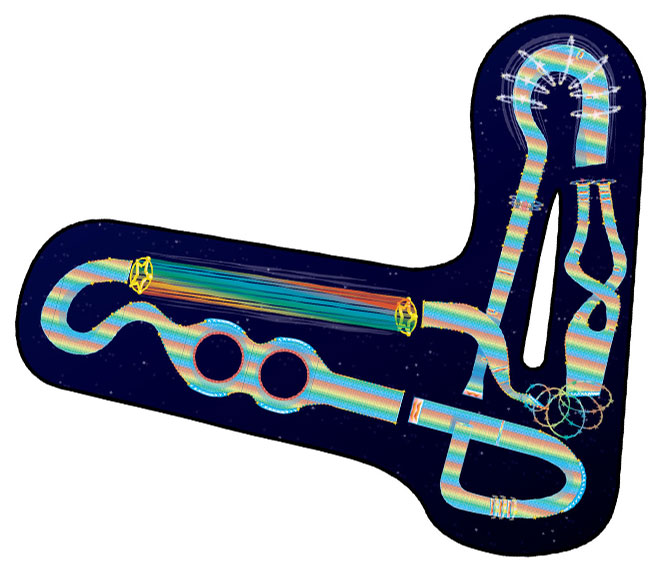
7 introduced the idea that courses could be only one lap, albeit a very long one. After Wuhu Loop and Maka Wuhu the last one-Lap track is this game's installment of Rainbow Road. There are not as many drastic elevation changes, but there are extended Air Portions, multiple path choices, and a wavy road full of holes reminiscent of the Wii version. This time, however, players drop down to the surface of a Moon. Dash panels abound again, and one of the course's more distinct features may be a long Rainbow Tube that doesn't quite do what the Spiral in
DS did.

The Course is truly in space. For the first time Players can drive not only on bits of Rainbow but the
rings of a Saturn-like Planet as well as what appears to be the surface
of a moon. There a a few places to catch some Air, the longer of which is full of Asteroids to dodge and Star Boosts to hit to keep up Air Travel. Failing to hit these can lead a Driver to either the course below or death. The track itself is a swirl of colours that evokes the vertical pattern of
DS but gives it a greater swirl like
Wii.
The Ghost here is the Honey Queen, perhaps due to her status as Intergalactic Royalty. The Normal uses the Birthday Girl, Slim Wheels, and Peach Parasol in 02:10.090
. This is a pretty good choice, but the Peach Parasol is egregiously slow in the air. The Expert switches to her own Bumble V, Standard Wheels, and Flower Glider in 01:52.077. This is again solid, although the Glider can definitely be upgraded. There are more turns, gaps, and last-minute decisions to be made her than a need for raw speed. The greatest straightaways are through the air, so pick someone with good handling and drift that maintains velocity in the Air. Something like the Bumble V, Cloud 9, or Pipe Frame, along with the Sponge or Wood Tires ought to do the job.
8:
The Rainbow Road here returns to much of what made the
Wii Rainbow Road great - set high in space with the Earth down below, with insane, impossible turns, split sections, and a massive air boost. Like
7, though, there is also some significant sections where no rainbow is traveled on, instead there exists a massive orbiting space station with shifting directional paths. It's also notable for being the only Rainbow Road with a small patch of Off-Road, though. It's completely allergic to barriers, and very easy to fall off when zooming along with anti-gravity. Anti-gravity, by the way, was made for this course, and it employs them perhaps better, or at least more extensively than any other course in
8.
Depending on your comfortability with that, you'll surely want someone with proper handling that won't fall into the abyss. The Ghost here is Pink Gold Peach, who uses the Comet, Slim Tires, and Super Glider. That's a damn fast combination but you can use the Slick Tires to get that anti-gravity speed up and perhaps someone with less weight for better handling during those deadly turns. The use of Peach in her Pink Gold diecast here may be a reference to her Ghost from
Double Dash, along with the use of Metal Mario in the
64 Rainbow Road.