Showing posts with label Wii. Show all posts

Sunday, June 2, 2013

Thwomp Desert

History:

Thwomps one of the oldest races in the Mushroom World. They were born out of volcanic rock and then hammered and smoothed by some Dark Evil Magic that even Bowser does not fully understand. They are nigh impossible to full destroy, and their own capacity for smashing is unparalleled. Yoshi came to own this parcel of land through his dealings in the Dry Dry Desert. An enormous Thwomp, however, was not pleased. See, Yoshi built the course on an Ancient Thwomp Burial Ground. The large central Thwomp, therefore, saw to it that anyone who ventured too close to the corpses of his fallen brethren would meet a certain vengeful doom.


Wii:

This is one of only two Desert Battle Courses, the other being Super Circuit Battle Course 4. It is a relatively simple course at first, but it ends up being a general hassle to play on. There is an abyss-filled pit in middle where the Giant Thwomp smashes every so often, so it's fairly awful to ever go near the center. When the Thwomp lands the ground also shakes, which leads any racer vying for a coherent strategy into utter turmoil. The spots of Dead Thwomps, though, are actually safe when this happens.

In general, your best bet may be hanging around the perimeter and picking other people off, but that cactus ring is also dangerous. This ends up being a tight, cramped course, but with a lot going on at any time, it can be hectic, especially with a lack of barriers to deter battlers around bananas or fake item boxes. Bob-ombs, actually, are particularly effective here because it's difficult to react in the mass chaos that goes down.

Friday, April 12, 2013

POW Block

History:

For many years Item Factories within the Mushroom Kingdom had manufactured their only superweapon against the Koopa Troop - the POW Block. Soon the POW Corporation was established as an LLC distinct from the Mushroom People, and it grew to create other products, including Cars sold along the Moonview Highway. Once activated, the POW would magically stun anything connected to the ground. Through some controversy, the POW Corporation was able to petition their Block into the 2008 Grand Prix, but it as many of the racers, namely the Koopa Troop, found that such cavalier use of the weapon made light of the damaging effect it had had on their people over the decades, it has not been seen since.

The POW Block appears in:

Wii


The POW Block works similar to the Blooper in that it affects all of the racers ahead of the activating driver. Once activated, it will appear above the heads of all the other drivers and countdown to a devastating spin-out effect. True to its use in the mainstream platforming Mario Games, though, it can only affect the racer if he or she is on solid ground. Thus it is negated by jumps, cannons, tricks, and even well-timed hops. It is therefore not as effective an item when competing against seasoned racers, although the timing can be difficult during complex crowded race scenarios or tricky portions of the course. Therefore, the POW is most effective if it is activated just prior to a crowd of racers, a particularly hazardous section of course, or right before a jump, but not during it, which would cause competitors to lose momentum going up a ramp.

The POW does not affect racers who have activated a Star, Bullet Bill, or Mega Mushroom.


Tuesday, April 9, 2013

Chain Chomp Wheel

History:

While typically the Koopa Troop had invested in small-scale Battle Courses simply integrated onto their many Island Beach Properties, such as Battle Course 2 and Palm Shore, they went all-out for the Epic Construction of the Chain Chomp Wheel. Off the cliffs of Koopa Cape the Troop experimented with more Pipe Technology, eventually building a giant underwater dome that housed an enormous yet docile Chomp. Bowser, with ever the controlling interest in the investments of the Koopa Troop, nevertheless named the Arena, Chain Chomp Wheel to apply the terror commonly associated with the ravenous Chain Chomps. Also despite its resemblance to a roulette, it has no officially sanctioned gambling use, although Bowser has been known to take bets on where the Chomp may chomp a Racer.


Wii:

Chain Chomp Wheel is very much the spiritual successor of Tart Top, itself a successor of both Cookie Land and Big Donut, so this may be seen as a slicker departure altogether from the pastry theme. Essentially though, all these courses have a large circular battleground around a smaller, non-traversable center. In Chain Chomp Wheel, this center area is actually reachable with some difficulty, but is essentially a large circle surrounded by boost ramps that shoots the player through a large rotating star. The great thing about hitting the Item Box in the Star's Center is that it always contains a Star.

This arena is massive. The ring around the center that contains the majority of the Item Boxes as well as the semi-eponymous Chomp is the Kill Box for sure and a great spot to leave a ton of Defensive Items like Bananas or Fake Item Boxes. Around the fringes are some panels that can boost players to other Item Boxes on high, which is good area to collect and fire Offensive Items like Shells or Bob-ombs. There is a bit of trickiness when the rotating plates aren't moving in the same direction you are, which can lead to some slow or shifted racing, but none of that is mandatory. The biggest danger is the Chomp, but that moves slow enough to be avoided easily, as long as you're paying attention.

The high number of Dash Panels present also make it easy to both escape harm and undo any obnoxious Blooper effects. Like Funky Stadium, this course finds a nice balance between being big enough to avoid overwhelming players and also being open and intimate enough to ramp up the action. It's also a groovy place to drive by and try to spy the Unagis swimming by the window. And as mentioned earlier, if we're getting technical about things, there is no actual Chain Chomp present in this course.

Friday, April 5, 2013

Thundercloud

History:

While Bowser had years ago harnessed the power of the Thunderbolt to work contrary to the Star, it was only recently that he developed a more personal variation of the Magic Lightning. As the Purity of Star Power, or even Mushroom Technology, continually eluded his grasps, he again attempted to use his knowledge of Dark Magic to work through alternative speed boosts. He struggled mightily to come up with a means to use Lightning Power to achieve the same ends. Using Lakitu Cloud Technology, he isolated the Thunderbolt to only strike a single player at a time, which at small doses, would charge them with incredible force and speed. Prolonged exposure, however, led to a similar effect as the course-wide Thunderbolt calamity, except isolated to one driver. Bowser, ever the gambler and delighted that his new weapon could be used defensively and offensively, decided to go ahead and submit his imperfect technology, although it was only accepted to a single Grand Prix.

The Thundercloud appears in:

Wii

The Thundercloud is an intriguing item because of its aforementioned defensive and offensive nature. Once activated, the personal storm cloud boosts the user with Lightning, which provides a sustained speed nearly equivalent to a Mushroom Boost and negates Offroad Conditions. Once the Lightning runs out, however, the user is struck similar to a Thunderbolt effect, except he or she is the only shrunken player. The catch is, that at any time the Thundercloud may be transferred to another racer through physical kart-to-kart contact. If your timing is correct, this means that you can get all the benefits of a speed boost, and then ram into someone and pass off the ill effects. However, this means that the Thundercloud virtually cannot be used to get into First Place, because when there is no longer anyone around, you will shrink, wither, and fall behind.

There are other plays to be made, however. It is risky, but if there is a crowded pack of racers you may attempt to grab the Cloud from someone else, boost forward, and then keep passing it. This is dangerous, though, if you do not know how long the first person has had the Cloud activated. Another decent strategy if you get ahead is to actually slow down in a narrow stretch and try to let someone from behind run into you. This will give them an advantage momentarily, but when they shrink you can surge ahead.

Like Mushrooms, while the Thundercloud grants a boost, it does not grant Immortality like Stars do. This means that while speed is increased, the potential for hazards also increases. Thunderclouds are negated by Stars, Mega Mushrooms, and Bullet Bills. In general this an Item to avoid because of the high amount of advanced strategy required to effectively deploy, as well as the risk that often is higher than the reward, especially when compared to other Speed-granting Items. Any good effect is essentially negated by the time it runs out if there are no other drivers nearby. It requires timing more complex than perhaps any other Mario Kart Item.

Wednesday, April 3, 2013

Funky Stadium

History:

While Donkey Kong had always invested a great deal of time and effort into constructing courses and participating in the Grand Prix, his bro Funky Kong had a far more laid back approach. Funky had amassed a sizable fortune through the transportation, mechanical repair, and arms dealing industries, and eventually turned this into an expression of his true love - extreme sports. Funky Stadium was designed to exhibit motocross, skateboarding, and monster trucks, but when approached by the Battle Stage Planning committee, Funky was easily able to adapt it to Kart use. It proved immensely popular, if only because it had one of the largest capacities of any venue affiliated with the Grand Prix.

Wii:

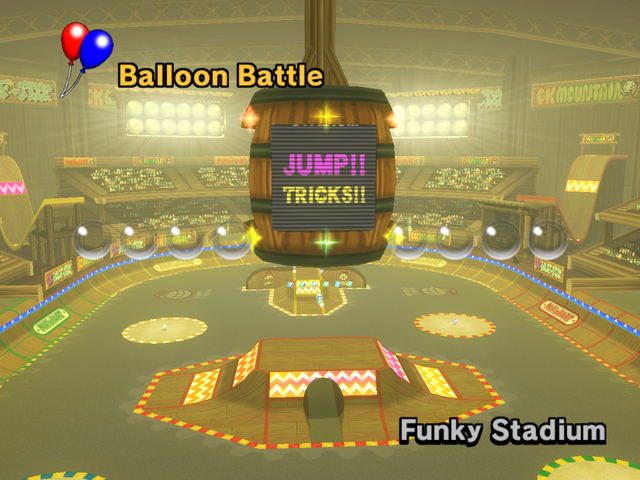
Funky Stadium is massive, but it never feels that way. It's the best Mario Kart can do towards emulating Tony Hawk's Pro Skater, and uses the trick feature of the Wii to an extent better than any other Race Track or Battle Course. There are half-pipes and ramps and hills and all other kinds of crazy props. It is a huge course, but it is also relatively open despite the high number of walls and jumps. This makes it a very fast course, although at the same time there are many nooks to explore and hide in.

There's a Humong-O-Tron at center court to keep track of the score along with the occasional sand patch that will slow players down. Since those patches also contain an Item Box, it's not a bad spot to nail a hapless opponent, namely because if they're foolhardy enough to be charging there, they likely don't have an Item already. Although an abundance of dash panels nearly make Bloopers obsolete, the wide open spaces make for great Banana Mine Fields, whose treachery would be aided by obscured vision.

This is really one of the funnest Battle Courses in all of Mario Kart. Maybe it's just the funkadelic energy in the air or the chance to cut loose with plenty of trick to occupy yourself in between the mayhem, but this is always a must-land on the Battle Stage Roulette.

Monday, February 11, 2013

Delfino Pier

History:

Off the coast of Delfino Plaza, adjacent to Delfino Square on the Isle Delfino lies the Delfino Pier. Yeah, they aren't very creative at naming things. With both Princess Peach and Princess Daisy making significant investments in race courses throughout the Isle, Mario felt slighted. He was unable to push through another Racing Course, but did secure a large tract of land to create a Battle Course. The result was more exploitation of the Piantas people, but they were just honored to have the presence of the Hero Mario on their Isle.

Wii:

The Delfino Pier is a unique Battle Course in that the fighting area shifts as time progresses throughout the battle. There is no way to alter these shifts. The battle begins atop this giant roof surrounded by water that rolls in and out with the tide. There are some hidden sneaky areas but they are rarely traversed by the enemy and not worth exploring. There are some dash panels to pull of some sick jumps that will also get rid of any Blooper Ink. As time goes on though, new areas open up, including a large indoor area that also gradually fills with water, becoming a certain way to die. Finally, the drawbridge drops and battlers finish the fight atop a higher, pyramidal roof. This usually is a decently high-scoring match, although it is actually large enough and contains enough obscure areas that players can easily hide and regroup. What's the fun in that, though?

For strategy, try to maintain the high ground and be aware when things start to change on the course, signified by the donging of bells. The course is simultaneously expansive, yet enclosed by tight corners and isolated confined spaces. Avoid the corners and dash when you can to soar to other parts of the course. Also pay attention to when players fully diffuse to other areas. Oftentimes someplace new will open up but battlers won't journey there. Stick where the action is and rack up those points.

Saturday, February 2, 2013

Bullet Bill / Chain Chomp

History:

Thousands of years ago, a young Rosalina, new in her job as Guardian Mother of the Galaxy, began to experiment with some of her new-found star power. She did not believe that any harm would come from using her star power on meteors to bring them to life, but instead in her inexperience she created a ravenous new species that sought only to consume. Horrified at what she had done, she sent the meteors away throughout the Galaxy. Eventually they wound up in Mushroom Space, where they would continue to devour everything, even Rainbow Road.
Some fell to the Mushroom Kingdom and were worshiped as gods by the early peoples of the Dry Dry Desert. Soon tribute was not enough to satiate their horrendous chomping appetite, and they were chained in tombs. Still, eventually there grew a group of professional Chomp Wranglers who would capture the beasts and train them up as sleepless, ever-vigilant and ever-hungry guard dogs. Mario was just one of these Wranglers, and he installed Chomps to guard his lover, Peach's castle. His younger self from an earlier timeline, though, Baby Mario, eventually found a way to use them in the Grand Prix, but in the rash judgment of youth, the results were imperfect. Still, this experience likely led the present-day Mario to become so familiar with the Chain Chomps.

After the disastrous introduction of Chain Chomps to the Grand Prix it was decided to use an Item that was similar, but far less risky for the activating driver. Bowser submitted his own Grand Stockpile of Bullet Bills, the Mushroom Kingdom equivalent to WMDs. Bullet Bills are created in Massive Factories in the Dark Land, and although sentient, are aware that they exist only for kamikaze missions. This combination of destructive power, spacial awareness, conscious decision-making, and unwavering loyalty makes them one of the most powerful forces in the entire Mushroom World. Being chosen to be an Item in the Grand Prix spares a Bullet Bill from its usually suicide mission, but such is actually against the Code of the Bills, which dictates that they die in battle. Thus, while being picked for life would seem like a huge relief, it is one of the deepest shames a Bill can suffer.

Chain Chomp appears in:

Double Dash!

The Chain Chomp only appears as a Special Item used by Baby Mario and Baby Luigi, as well as King Boo and Petey Piranha, who have access to all Special Items. It is dangerous and unwieldy and awesome and powerful at the same time. The Chomp will pull the racer at a rapid speed while knocking everyone else out of the way. The Driver himself though, is not invulnerable, and still susceptible to dangers on the course. It is also uncontrollable, the Chomp will tug the racer straight into danger, or suddenly leave before a cliff or turn that may pull the racer into oblivion. Still, the Chomp takes up nearly the entire track, and avoiding one coming up from behind is very difficult.

Bullet Bill appears in:

DS
Wii
7


The Bullet Bill in later games is very much a refined version of the Chain Chomp. It pulls the player ahead and destroys all other obstacles in its path. The key difference is that it encapsulates the racer, rendering him or her invulnerable to any disaster on the track. The Bullet Bill can supersede any danger besides a Star. It conquers Mega Mushrooms, and is unaffected by Thunder, POW Blocks, or Bloopers. There is still some danger of it wearing off and leaving racers flying headfirst over a cliff, but the benefits far outweight this mild risk. It's arguably better than a Star, especially on difficult tracks where it will take over the driving and launch the racer ahead. There isn't the danger of screwing up or junking turns because of high speed handling. Bullet Bills are game over, man - they only appear for players who have fallen far behind, but they offer a great advantage.

Blooper

History:

The Bloopers peacefully control large swaths of the Mushroom Seas, only acting out when their waters are intruded upon. Their commander is King Calamari, a giant squid-like creature. As contact grew between the Land and Sea societies, the King brokered a deal to let his denizens take part in the Grand Prix, as items. The Bloopers only contain a rudimentary understanding of their role in the races, though, and are mostly eager to return to their more familiar undersea existence.

Bloopers appear in:

DS
Wii
7

Bloopers function similarly in every game in which they appear. They are typically an item that appears to players towards the back of the pack. Once activated, the blooper soars out to every racer ahead of the one who used it and covers their screens in ink. It's one of the only items that breaks the fourth wall in Mario Kart, not actually affecting the driver, but rather the ability for real-life human players to perceive their video game avatar. It creates a visual disruption between the user and the proxy of game play.

This can be deadly, but again, it doesn't actually affect the potential of the actual avatar, just the ability of the player to see the screen. It can therefore be dealt with by either carefully memorization of the course, errant item placement, and predictable patterns (Thwomps for example); anticipation of incoming objects via auditory cues and the portions of the screen that do remain visible; and finally, prayer. If the Blooper is used while the racer is in first place, it will only attack the Kart that used it, namely, you. So, don't do that.

Any boosting object can get ride of the Bloop Ink. That is, any dash panel, trick, star, bullet bill, cannon, mushroom, or mega mushroom will do the trick. For this reason, Bloopers are actually less deadly on more complex tracks where you'll hit this stuff all the time. Of course, on simpler tracks, the screen obfuscaton is not nearly as terrible with much less danger. Therefore, there are only a couple courses where the Bloopers are actually effective, mostly those with lots of danger, crowded spaces, and a lack of boosting opportunities. It's also really a catch-all item. Unless you can see the racers ahead of you to time it so you ink up their screen right before they hit a tricky part of the course, there's no real timing or strategy involved. Just let the little squid do its thing and hope for the best.

Tuesday, January 1, 2013

Bob-omb

History:

The Bob-ombs are an Ancient Race that has inhabited the heart of the Mushroom Kingdom for centuries. Eons ago a Dark Lord sought to create a race of sentient living weapons and so placed his Dark Power into hundreds of his bombs to use against his enemies. They were to be the perfect weapon - a walking, thinking, chasing explosion on legs. They eventually broke free of the Lord's control, though, and settled far away in the Mushroom Kingdom. Eventually though, Bowser gained their Allegiance through his puppet, the Big Bob-omb. Since then, the populace has fractured and battled, with the Pink Bob-omb Buddies continually at strife with the Black Followers of Big Bob-omb. Their Kingdom has turned into a Battlefield, and remains the closest intrusion of Bowser's Dark Influence within the Mushroom Kingdom.

Bob-ombs appear in:

Double Dash
DS
Wii
7

Bob-ombs began as the Special Item for Wario and Waluigi in Double Dash. Their use was equally sinister and retarded enough to suit the Stupid Evil of those two goons. In every game since then, though, Bob-ombs have returned as Items available for everyone's use. And that use is always deadly.

Bob-ombs are extremely volatile. They'll pop with the slightest touch of just about anything. They may be placed behind or thrown forward and thus their use is similar to Bananas or Fake Item Boxes. While those items will either hit players and disappear or remain idle and small on the track, Bob-ombs are far more deadly. They will erupt in an explosion similar to a Blue Shell if struck, or just on their own after a few seconds. The thing is, those seconds tend to be exactly how long it takes to catch up them when thrown forward. Therefore, unless you've got a great clear shot at hitting someone immediately when going forward, I would always toss it behind. The huge size blast radius is extremely difficult to avoid, especially in Double Dash where only the Heavy-Kart Wario or Medium-Kart Waluigi can wield the Item.

They are also dangerous to drop behind, though. If you drop it directly on someone sneaking up from behind or it gets hit with a Shell or something, you're donezo. It's not a bad strategy to try to peg a Bob-omb if you see someone ahead of you drop it and you're lucky enough to be equipped with something that can ignite it. Otherwise, that's not good news for you coming up behind. These things are generally a disaster in every way. They're only good in DS where they may be stolen by someone with a nearby Boo.

Fake Item Box

History:

Races underwent many changes during the Second Grand Prix. For the first time, Item Boxes were created rather than panels. During the first wave of their production though, many proved faulty. Instead of giving an item, they would explode and crash the racer. Soon after the technique for Item Box creation was perfected though, competing companies made knockoffs that were still faulty and sold them to individual courses, much to the danger of competing racers. Eventually the Grand Prix Governing Body reconciled the safety of racers with the concerns of the many new and growing factories that had sprung up to support the Races. The faulty Item Boxes were slapped with an inverse Question Mark and progressively labelled "Fake." They would, however, be accessible by true Item Boxes and used by drivers during the course of a race.

The Fake Item Box appears in:

64
Double Dash
DS
Wii
7

There have been some variations of the Fake Item Box throughout the years, but the purpose has always generally been the same. It is another, more deceptive means than Bananas for Lead Drivers to knock around those racing behind them. Indeed in 64 while running over a Banana was salvageable, Fake Item Boxes meant certain doom. 64 was also the game where the boxes where most similar to genuine Item Boxes, the only difference being the position of the Question Mark. In later games the boxes were red, or as in DS, lack a Question Mark at all. These make the boxes a tad easier to avoid.

Another major progression of the Fake Item Boxes throughout the history of Mario Kart is their physical properties. In 64 they acted very similar to Bananas - they could be dragged behind a Kart in order to prevent a Shell from crashing into the back. They could also be destroyed by shells moments before running into them. Their only real difference from Bananas is again, its greater deception, larger size, and an inability to throw them forward.

Most of this changed in Double Dash. Shells and other character-specific projectiles such as Fireballs and Chain Chomps would now pass through Fake Item Boxes, both when dragged behind a Kart or laid on a track. When Karts are hit while dragging, the Item is not lost, though. The Fake Item Box can be launched forward, however, making it an offensive weapon as well, as tricky as it is to peg a moving Kart from far away.

There are many strategies to both using Fake Item Boxes and avoiding them. Careful racers who can memorize True Item Box locations on courses will not be deceived, even in 64. Still, they can be used effectively to block ramps or shortcuts, or at least narrow track sections where running into one is inevitable. Another good drop spot is in a cluster of True Item Boxes, possibly sitting directly on top of a True One, even though timing this can be difficult. Still, limiting the amount of Item Boxes accessible to the competition is a good thing. Their offensive use can still work in rare circumstances, although it's rare that they will appear in positions deep in the pack. If there is a situation where you receive a Fake Item Box and are then passed, it's best to try to chuck it into a crowd, or a particularly deadly maneuver is to launch it into a True Item Box cluster that another racer is about to pass through. It's tough to react to things falling out of the sky, and the CPU will rarely be able to anyway.

Wednesday, August 22, 2012

Haunted Mansion Stages

History:

The Boo Woods were once one of the most wealthy sections of the Mushroom Kingdom, filled with lakes, docks, and mansions. It was a heavy wine producing region as well as a tourist destination. As the Woods fell into disarray though, they were abandoned as the Boos, the Restless Souls of the Deceased Inhabitants, took over. After a long period of deception, Luigi came to acquire one of these mansions .Having no real use for the mansion, Luigi thought it easiest to convert it to a Battle Course, and later, a Race Track.

Another Battle Course was converted out of the Twilight House, a large mansion hovering over the Void that surrounds parts of the Twilight Trail, located in the region around Rogueport in an isolated Reach of the Mushroom Kingdom. Dry Bones took charge of the course, although it was clear he was merely acting as a conduit to Bowser's interests in the region controlled mostly by other evil rivals.


Double Dash:

Luigi's Mansion is similar to Double Deck from 64 with its different levels and ability to drop off the third floor back to the starting area. It's a pretty decent stage with some tricky winding hallways and some nefarious corridors on the bottom level. The Central Ballroom also tends to be a Death Zone, where people can lay traps for those careening off the Top Level with little idea of where they're headed.

DS:

The Twilight House appears in DS, which we paired with the equally creepy Dry Bones who made his debut in that game. It's aesthetically similar to Luigi's Mansion, but lacks the different levels and wide spaces. It's a tough course because of the many right turns and isolated rooms, which makes running into other drivers sudden and painful. The time spent in between these terrifying moments, though, is rough.


This course returned in Wii with some minor adjustments. The influx of racers in Wii makes it a crowded track and it's easy to accidentally crash into a Banana or Fake Item Box. There is no real difference between the open areas and the indoor areas. There are lots of dastardly spots to place items and shells zipping around can get nasty real fast. Still, it can be a difficult arena to seek out and target Racers because so much can interrupt a hunt while the prey zips two rooms over.

Cookie Land

History:

Princess Peach was a just ruler of the Mushroom Kingdom, but her obsession with baking at times strained the nation's resources. When she decided to create a Battle Stage from scratch, she naturally chose to make an enormous cookie in the heart of Yoshi's Island. Not only was it difficult to procure the vast amounts of sugar, flour, and butter to originally create the massive cookie, but the stage would damage easily, cracking and crumbling under the weight of the racers. The course was popular, though, and it would return for the 2008 Battles. With many more drivers in this installment along with much heavier karts, the strain on the Cookie was tremendous. Eventually Toad swapped in an entirely new stronger Cookie Material mined from the Sweet Sweet Galaxy. Now located in the Mushroom Kingdom, this has held up far better, although the Princess was kept unaware of this maneuver.


Double Dash:

Cookie Land follows in the theme of tracks like Big Donut - a big concentric ring with a few mild barriers. There aren't very many dangers here, but that tends to make the track a bit less interesting. The action is very spread out and it's more difficult to find and target other players.

The course returned in Wii with little changes, but it's a much better course. The mere fact that Wii battles involve twelve drivers makes it much more chaotic and interesting. Cookie Land becomes one of the highest-scoring maps in this game, with an inner ring full of death and an outer ring full of maniacal drivers making passes to send shells into said inner ring.

Friday, May 18, 2012

Thunderbolt

History:

It was Bowser's Dark Magic that first harnessed the power of Lightning. Lying under the constantly stormy skies of the Dark Land, Bowser was able to capture the daggers from the sky and confine it to an Item Box. Known more often as the Thunderbolt, this item was seen as counter to the Benefits of the Star. It would destroy all other players and allow its user to race ahead.

The Thunderbolt appears in:

64
Super Circuit
Double Dash
DS
Wii
7

The use of the Thunderbolt is similar in every game. Usually players have to be pretty far bac64 and Super Circuit, where the effects lasted longer and players were squished if run over (this returned in 7). From Double Dash on, Players are merely knocked around more easily, and from DS on players in a lower place would be affected for a shorter period of time.
k to get it from an Item Box. Once activated, every other player on the course is struck by Lightning and shrinks down to a miniature size. This makes them much slower, as well as more vulnerable to hazards on the course, including other racers. It was arguably a more fearsome weapon in

The only thing that can counter Thunderbolts are Stars, or in later games, Bullet Bills. If a Racer in Wii is using a Mega Mushroom, he or she will be reduced to normal size. Mistimed Lightning is perhaps the most dangerous - if it strikes when going over a jump players will be punished into the Abyss. The only exception for many years was barrel cannons or other jumps that prevented the ill effects. When these kinds of jumps became conduits for Air Travel in 7 this protection was negated. This makes 7 a much more dangerous game, and indeed, with the squishing effect back in force, the Thunderbolt has some teeth again.

There's no telling when Lightning will strike. It's the number one reason not to hold on to items very long and is a great interrupter of strategy. From DS on, the Thunderbolt can cause players struck to lose their items, which was absent from 64 and Super Circuit. Generally this seems to happen whenever you've been holding a Red Shell for just the perfect moment to strike. It promotes a healthy turnover in gameplay.

Thursday, May 17, 2012

Super Circuit Battle Course 3

History:

Princess Peach would later be a great Battle Stage innovator through her massive cake baking, but in her earlier years she mostly just ripped off Mario. Her Battle Course 3 is based on many of the plumber's technical designs with almost no originality of her own. Still, she built it on the Royal Grounds next to the Peach Circuit.

Super Circuit:

There isn't a ton to go on here. It is basically a version of Battle Course 1 although there's a bit more sand in a rounded patch and four barriers rather than eight. Still, its simplicity is beneficial and there isn't a ton of room to hide.

The Stage returned as a Retro Course in Wii with basically no changes, except it's on a bit larger scale. It's well suited for a higher number of players that can create more hazards in the open terrain. The slow sand patch in the middle is a certain deathtrap and should be avoided. The rest of the stage tends to be filled with bananas, bombs, fake item boxes, and shells, and players ought to be on guard.

Saturday, May 12, 2012

Shells

History:

When the first Grand Prix Council got together to determine what Items would be used, Bowser proudly volunteered an offensive options: The Koopa Shell. At first he only supplied standard Green Shells, but eventually his Shell Technology grew more sophisticated. He added homing powers with Red Shells from Paratroopas and finally, the Blue Spiny Shell, one of the most rare and deadly of any of the Mario Kart Items. For the 2003 Tournament he added his own Bowser Shell, the most monstrous and gigantic of all Shells.

The Green Shell Appears in:


SMK
64
Super Circuit
Double Dash
DS
Wii
7

The Green Shell is one of the most basic, stalwart offensive options in Mario Kart. It has hardly changed since its earliest days in Mario Kart History. Once fired it travels in a straight line, bouncing off any solid wall until it crashes into a racer or falls off an edge. It can also be used defensively, being held behind a Kart similar to a Banana, where it will absorb the hit of any other Shell or shell-like item (This option was unavailable in Double Dash). It can be fired behind the racer when held here, which is helpful in some instances, for instance if a player is far ahead and there is a higher danger of firing it forward.

The Triple Green Shell Appears in:

64
Super Circuit
Double Dash*
DS
Wii
7

The Triple Green Shell in practice acts exactly like a Green Shell,  a straightforward projectile. It is also a very able defensive weapon, though, because once activated, all three shells will encircle a player. If drivers run into anyone else, the result will be as if the opponent had hit a Green Shell. Players are still susceptible to damage, though, if an Item penetrates the Shell Guard players will still flail out. This is less an issue when all three are activated but when only one or two shells are circling around players are more vulnerable. Of course, they are no more vulnerable than if they had nothing at all.

*In Double Dash this was a Special Item reserved for Koopa Troopa and Paratroopa. The Shells did not encircle the players, making them less useful defensively, but still a great offensive option.

The Red Shell Appears in:

64
Super Circuit
Double Dash
DS
Wii
7

The Red Shell has been a staple of Mario Kart games from 64 on. It fires forward like a Green Shell, but instead of traveling in a straight line and then bouncing off walls it homes in on the closest player ahead in the race. It will become defunct if it strikes a wall though, necessitating a degree of precision during Battle Matches with many walls, such as SMK's Battle Course 4.


The Triple Red Shell Appears in:

64
Super Circuit
Double Dash*
DS
Wii
7

The Triple Red Shell once activated acts exactly like the Triple Green Shell, encircling and protecting players. Once fired they act exactly like Single Red Shells, homing in on enemy players.

*In Double Dash this was a Special Item that only Koopa Troopa and Paratroopa could use. They did not circle around the Kart, making them less useful defensively, but they are very valuable to use to specifically attack a wide number of opponents.

The Blue Spiny Shell Appears in:

64
Super Circuit
Double Dash
DS
Wii
7

This is another fairly rare and legendary Item. It often comes up while racers are near the back of the herd and is one of the only such weapons that his used offensively from back there. Using the shell's wings, it flies and seeks out whoever is in First Place and messes up their day. From Double Dash on the disaster has become more significant, causing a great Blue Explosion that will also engulf any players driving around the Blue Shell.

It is possible to avoid the Shell, but this is tricky and lucky to do. The key is that the Shell doesn't pick its victim until that final plunge, which is where you can escape. Still, there are dangerous parts of the track where getting hit is not only inescapable, it proves disastrous. This includes over any gap and particularly in Mario Kart 7 in many Air Portions.

The Bowser Shell Appears in:


Double Dash

The Bowser Shell is the Special Item of Bowser and Bowser, Jr. in Double Dash and is a pretty useful item. The enormity of the shell takes up most of any track and it will clobber anyone in its path. There is some caution when throwing it forward though, as the thrower may become a victim as well. It's best on straightaways shot directly behind to annihilate anyone who is considering challenging you. It can be disrupted by Giant Bananas, although it will destroy the Banana, as well as Hearts, which can pick it up to be used by either Peach or Daisy.

The Yoshi Egg Appears in:


Double Dash

The Yoshi Egg has properties very similar to Shells, so it is included here. Technically the Yoshi Egg is the Special Item of Yoshi (as well as Boo and Petey Piranha) and a pink version, the Birdo Egg is the Special Item of Birdo. Both have exactly the same function and operate basically like a Red Shell, seeking out and destroying whoever the next in line is. The key though, is that once struck, the Egg will crack open with Items such as Stars, Mushrooms, Bananas, or Stationary Green Shells. It could also pop open a Bob-Omb. All this means that the Egg could either be very beneficial to the user, or it could be hazardous. It's even possible that the enemy struck will come away with a star. It's not that useful.

Bananas

History:

There is nothing more valuable on the DK Isle than Bananas. In a land rich with currency, Kong holds nothing above his precious Golden Banana Collection. During the Original Grand Prix when the Council deemed that every competing civilisation give up something substantial to contribute to the Item Panels, Kong let go of a few thousand Bananas. Ever since then, they have been a staple of the Tournament.

The Banana Peel Appears in:


SMK
64
Super Circuit
Double Dash
DS
Wii
7

The Banana Peel has appeared in every game since Mario Kart's inception. It is the primary defensive weapon and the most common weapon dropped behind players rather than in front. It can be used offensively by throwing it forward, but this is difficult to pull off with precision. Different games handled the Banana in different ways. In every game besides Double Dash players can hold the banana behind their cart as a defense against Shells and shell-like items, although if the Shell comes in by the Front or Side of the Kart this is useless.

In Mario Kart 64 players could also recover from crossing a banana if they didn't immediately peel out. In other games, Bananas lead to certain doom. It's always an Item more commonly encountered in Higher Places during the race and careful placement on the track will ensure it remains that way.

The Banana Bunch Appears in:


64

Mario Kart 64 also boasts the only appearance of the Banana Bunch. A version would return as the Triple Banana in later games, but 64 is the only one to feature the succession of five peels dragging behind a Kart. Not only did this allow players to leave longer trails of hazards, but they would have more dangers dangling behind their vehicles for players who travel too close to run into.

The Giant Banana Appears in:


Double Dash

This is an Special Item reserved for Donkey Kong and Diddy Kong. The Giant Banana is as it sounds - a monstrous frowny banana that takes up most of the track. it is one of the better defensive options and great for players ahead in Grand Prix because it will come up often and block everyone coming up the rear.

Once players strike the Giant Banana it will break up into Three smaller Bananas. The same effect will happen when a Bowser Shell hits it or a Chain-Chomp munches through it.

The Triple Banana Appears in:


DS
Wii
7

Ever since DS multiple Bananas have come in groups of three, not five like the Banana bunch. Besides limiting the amount of obstacles drivers can leave on the course there is no real difference here.

Mushrooms

History:

While the Mushroom People covet neither coins, nor bananas, nor stars, their main love is Mushrooms. Such huge Mushrooms are plentiful in the Mushroom Kingdom and shared by all. The love of Mushroom Breeding takes the interest of many Mushroom People and there have been developed many different varieties. When deciding the Items to be included in the Initial Grand Prix, the Council argued for hours over what resources the different lands should give up. It was eventually decided that the Dark Land would supply thousands of Green Shells while the Mushroom Kingdom would give up many of their own Mushrooms for the success of the Games.

The Mushroom Appears in:


SMK
64
Super Circuit
Double Dash
DS
Wii
7

The Mushroom works similarly in every game and has made an appearance in everything since SMK. It provides Drivers with a sudden, temporary burst of speed that allows them to cut through offroad patches, knock around other players, or just gain some ground. It does not, however, render players invincible, and as such they are still vulnerable to any hazard the Course has to offer. If during this speed boost, players hit other drivers they will steal an opposing item. In Battle Mode this means that players will steal a balloon.

There are other ways to get Mushrooms on a course. Sometimes they are hidden in boxes or under piles of leaves, and if Goombas are struck by Lightning they will revert to their once-innocent Mushroom status.

The Triple Mushroom Appears In:

64
Super Circuit
Double Dash
DS
Wii
7

This item has is identical to the Mushroom but players receive three at a time. Since it was introduced in 64, it has been included in every game to date.


The Super/Golden Mushroom Appears In:


64
Double Dash*
DS
Wii
7

Known as either the Super Mushroom or the Golden Mushroom, this has appeared in every game since 64 with the exception of Super Circuit. Once activated, it grants players the effect of a Mushroom for an unlimited amount of times within a limited time period. This is another item that players will often receive when they are hanging out towards the back of the pack, and can be dangerous if they are activated on a complex course with many edges leading to the Abyss.

*In Double Dash this item was not available to everyone, but rather it existed as Toad and Toadette's Special Item. It is not that useful because it will not appear if players are in a High Position already. Therefore it is more well-suited for novices.

The Mega Mushroom Appears In:


Wii

The Mega Mushroom gives players the effect of what Mushrooms typically do to Mario in mainstream games: Make Huge. Once huge, players will get a speed boost as well as the ability to crush other players and obstacles. Nigh omnipotent, Mega Mushrooms still fall prey to the Star.

Star

History:

Stars are the source of the most ancient power in the Galaxy. The combined power of the Stars fuels Rosalina's godlike abilities, and when twisted, most of the Dark Lord Bowser's as well. It can sustain entire Galaxies or Kingdoms in power and the limitations of their use are determined solely by the mortals using them. In the hands of someone pure, like Mario, the Stars are used to rejuvenate and replenish decimated Kingdoms and Peoples. In the hands of Bowser they are used only to torment and destroy.

Their use in Mario Kart was controversial. They are so powerful that when setting the Items many racers had reservations, which come up whenever the Council decides what to include in the next Grand Prix. It was determined in the initial Tournament that the effects of a Starman be temporary, but during that time, very substantial indeed.

The Star Appears in:


SMK
64
Super Circuit
Double Dash
DS
Wii
7

The Star is the end-all of all items. It supersedes every other Item and ability. When using it players are invincible, their speed becomes comparable to the use of a continuous Mushroom, and they don't lose anything by traveling over rough terrain. If you are lucky enough to get one, usually when closer to the bottom of the pack, there is nothing better for making your own shortcut.

The Star beats Bowser Shells, Giant Bananas, Chain Chomps, Bob-Ombs, and Fireballs in Double Dash. In Wii it takes precedence over players activating either Bullet Bills or Mega Mushrooms. In all games players will be invulnerable to Lighting as well as Blooper Attacks. The only thing that can halt the Power of the Stars is a plummet into the Abyss.

Skyscraper

History:

With the wild upsurge in Battle Courses, development became a hot commodity in the mid-90s, although it still paled in comparison to Grand Prix Tracks. Toad, always the cunning and conniving politician who had his hands in a plethora of business deals, turned the roof of the Flagship Skyscraper in Mushroom City into a popular course. With a gorgeous view of the surrounding city, the Skyscraper tract attracted many to Mushroom City - just as Toad predicated.

64:

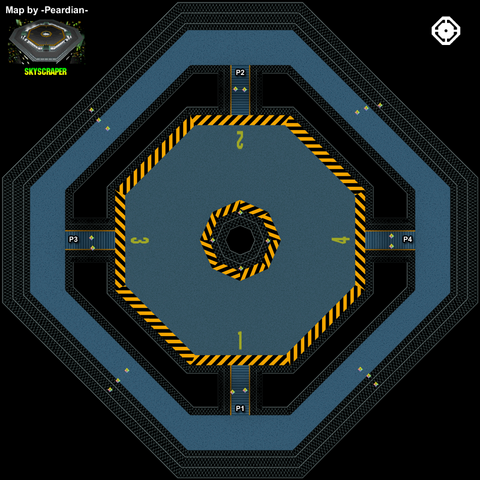
Skyscraper is a dangerous course. The outer edges all lead to the Abyss, as do cracks separating the inner circle to the outer rim. The very center is also a pit towards death. The rest, though, is relatively wide open, which means Battlers are open to destruction. Because of the open edges and plenty of drops though, Shells do not last long or bounce around with any frequency, meaning that if you are going to take someone out you have to be precise.

The track returned as a Retro Stage in Wii. Its layout is not tremendously different although it is much, much bigger. It is also more colourful and the ramps around any of the edges are far more exaggerated. Most of the action is on the outer room, driving loops and jousting with enemies. The center is generally hazardous like most Battle Stages and as things spread out along the Rim things are safer.

Block Stages

History:

The First Block Stage was created by Mario for the second installment of the Kart Games. Named Block Fort, it lay in the heart of the Mushroom Kingdom and provided the greatest Battle Spectacle of the time. Within a few years with Mario busy with other properties it came into the hands of Donkey Kong, who heavily renovated the arena, transforming it into Block City. As it fell into disrepair over the years, Mario eventually won back the rights. This time, though, he decided to share it with Luigi, Peach, and Daisy, who issued joint control of the stage. As such they erected massive statues of themselves in the course to demonstrate their wide control over Battling Interests.

64:

Each Console Mario Kart has a Block Stage, although the first is superior to all others. Block Fort is a multi-leveled splatterfest and one of the more popular stages out there. After a few rounds of Triple Green Shells the lower levels become almost undrivable, and the top most tend to have narrow pathways that are easy to get blown off. There are plenty of tight corners to interrupt the paths of Red Shells and clusters of Item Boxes perfect for drops of Fake Item Boxes. Any ramp can also become deadly with a string of Banana Peels. Also because of its straightaways it's one of the easier courses to ram smaller players and rob them of a Balloon.

The Course returned in DS with much brighter hues than the N64 standard Green, Yellow, Red, and Blue. Not a tremendous has changed besides the addition of a few items, most notably the Bob-Omb.

Double Dash:

Block City is one of the simplest courses in Mario Kart History, but that also makes it one of the most effective. It is small and essentially flat, although there is a slight incline leading up from the dead-end corner by the Blue Sector. There isn't really anything fancy about each sector, besides the pathway through the Yellow Blocks and the ability of the Blue Block to shadow some portions of the course. There isn't a safe part of this track, and items like Bowser Shells and Giant Bananas can devastate the narrow corridors. Because of the confined nature of the Stage you may have more success with smaller players, but ultimately a Red Shell will find its target no matter who you are.

Wii:

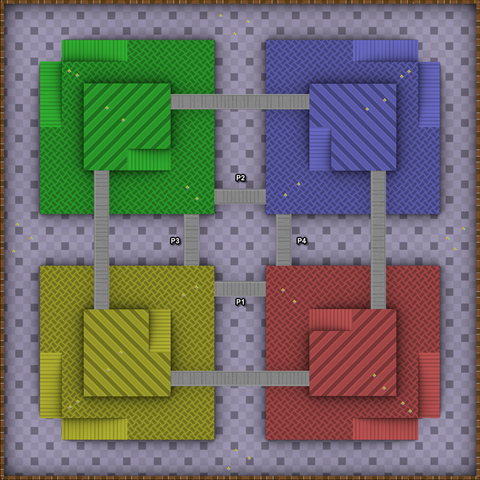
Block Plaza essentially combines bits from both Block Fort and Block City. Like Block Fort it has multiple levels connected by ramps and boardwalks. The block structure, notably the cut through the yellow path, though, and its low, confined nature is reminiscent of Block City.

Unlike either of these though, after a few minutes of play parts of the stage descend into the abyss, creating dangerous gaps for players to descend to their doom. It also has quadrants of each colour like Block City, but the main ramps lead to big bases with statues of Mario, Daisy, Peach, and Luigi that offset these quadrants, as well as a central purple base in the center. This makes for very different gameplay than the other cutthroat Block Stages. The High ground is essential here, using Shells or even Bananas, one can pick off doomed players. The Center Ring tends to be deadly, while the outer rims are where much of the killing can take place if you corner players one-on-one.